

If you've read the last two pieces in this series, you already understand the problem RAG solves — you just haven't heard the term yet.
We've talked about why raw transactions need to be turned into real understanding, and why a generic chatbot can't answer a financial question without knowing your actual financial life. RAG — retrieval-augmented generation — is the piece of machinery that connects those two ideas. It's the reason Finu can sound like a fluent, thoughtful conversationalist and be grounded in your real numbers, instead of picking one or the other.
The open-book exam, basically
Here's the simplest way to think about it. A foundation model — the large language model doing the actual talking — is like an extremely well-read student sitting a closed-book exam. It's absorbed an enormous amount of general knowledge during training: how language works, how financial concepts relate to each other, how to explain something clearly. What it hasn't absorbed is your bank statement. It was never in the room for that.
RAG is what turns the closed-book exam into an open-book one. Before the model answers, a separate system goes and finds the exact pages it needs — in this case, the specific pieces of your financial history that are actually relevant to what you just asked — and hands them over. The model still does the writing. It just isn't writing from memory anymore. It's writing from your file, opened to the right page.
That distinction matters more than it sounds like it should. A closed-book answer is a guess dressed up in confident language. An open-book answer is confident because it's allowed to check first.
The two moving parts
Under the accessible explanation, there are really two systems working together, and it's worth naming them plainly.
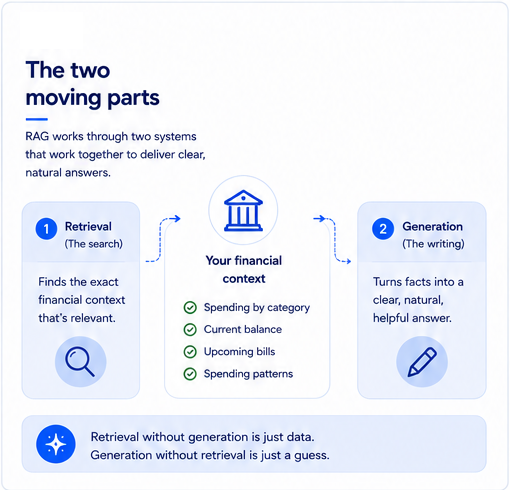
Retrieval is the search step. When you ask Finu something, this layer figures out what information would actually be needed to answer it well, and goes and finds it — your categorized spending in the relevant category, your current balance, a recurring bill that's about to hit, a pattern that's been building over the last few months. This is typically done with techniques like embeddings and vector search, which is a technical way of saying: the system understands meaning, not just keywords, so "eating out too much lately?" and "is my dining spend high this month?" pull the same relevant data even though the wording is completely different.
Generation is the writing step — this is where the foundation model comes in. Once retrieval has handed over the right facts, the model's job is to turn those facts into a clear, natural, useful answer. This is the part the model is genuinely excellent at: taking information and explaining it well, in plain language, in a tone that actually sounds like talking to a person.
Neither half works alone. Retrieval without generation is just a database query — accurate, but not something you'd want to read. Generation without retrieval is fluent, but ungrounded — which is exactly the "confident guess" problem from the last piece in this series.
Why not just use the foundation model by itself?
It's a fair question. Foundation models are genuinely powerful — so why not just point one at a finance question and let it go?
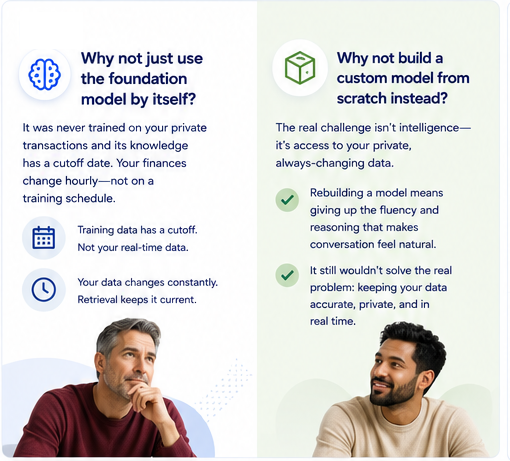
Two reasons, and they're both structural, not just quality issues. First, a foundation model's knowledge comes from training data with a cutoff date, and it was never trained on your private transaction history in the first place — it couldn't have been, that data doesn't exist anywhere the model was trained on, for good reason. Second, even if that were somehow possible, baking your specific, constantly-changing financial life into a model's weights would mean retraining that model every time you bought a coffee. That's not a real option — your balance changes hourly, not on a training schedule.
Retrieval sidesteps both problems entirely. Instead of trying to make the model "know" your finances permanently, Finu just hands it the current, accurate facts at the exact moment you ask. Your data stays current because it's fetched fresh every time, not frozen into a model somewhere.
Why not just build a custom model from scratch instead?
The opposite question is just as reasonable: if foundation models have this blind spot, why not train something proprietary that knows everything from the ground up?
Because the blind spot isn't really about intelligence — it's about access to your private data, which is a retrieval problem, not a "the model isn't smart enough" problem. Foundation models are extraordinarily good at language, reasoning, and explanation, largely because of the sheer scale of general knowledge they're trained on. Trying to rebuild that from scratch, in-house, would mean giving up the exact strength that makes the conversation feel natural in the first place — and still not solve the actual problem, which was never a lack of general intelligence.
So Finu's approach keeps the part that's genuinely hard to replicate — a foundation model's fluency and reasoning — and pairs it with something purpose-built: an intelligence layer that knows how to retrieve your specific financial context precisely, accurately, and privately, right when it's needed.
What actually gets retrieved
This is where the earlier pieces in this series come back in. The categorization and pattern recognition covered in the first post, and the balances, upcoming bills, and history covered in the second, are exactly what the retrieval layer is built to pull from.
Ask about your dining spend, and retrieval scopes in narrowly — your dining transactions, the relevant trend, nothing else. Ask a broader question like "how am I doing this month?" and it pulls more widely — balance, pace of spending, anything unusual against your normal pattern. The retrieval is scoped to the question, not a blanket dump of your entire financial history into every response. That's part of what keeps answers sharp instead of bloated: the model only gets handed what it actually needs to answer this question well.
Why this makes it personal, not just accurate
"Personal" gets used loosely in software, but here it has a precise meaning: the answer is built from data that belongs to nobody else. Retrieval is what makes that literally true, response by response. Two people could ask Finu the exact same question in the exact same words, and get two genuinely different, individually correct answers — because the retrieval step pulled two completely different sets of facts before the model ever started writing.
That's the throughline for this whole series. Categorization and pattern recognition turn your raw data into understanding. Context and memory turn that understanding into something ongoing, not a single snapshot. RAG is the architecture that connects all of it to the conversation itself — pulling exactly the right piece of your financial life, at exactly the moment you need it, and handing it to a model that knows how to explain it clearly.
It's not a feature bolted on for the sake of sounding technical. It's the actual reason a question you ask Finu gets an answer that's yours, and not just a well-written guess.