

Most credit is designed around a simple idea: lend money, charge interest, repeat. It's a model that works great for the lender and can quietly work against everyone else, especially anyone who ends up carrying a balance longer than planned. We built Finu Credit because we didn't think that trade-off should be the only option on the table.
Here's the plain version: Finu Credit is credit access built into your Finu membership, with no interest charged on it. Not a low introductory rate. Not a promotional window that quietly expires. Zero-interest, as a standing feature of being a member — not a limited-time hook to get you in the door.
What "zero-interest" actually means
It's worth being precise here, because "zero-interest" gets used loosely enough in consumer finance that it's earned some skepticism. For Finu Credit, it means what it sounds like: when you use it, you're not charged interest on the balance. The cost structure isn't hidden in a rate that kicks in later — it's built around your membership itself, not around what you borrow.
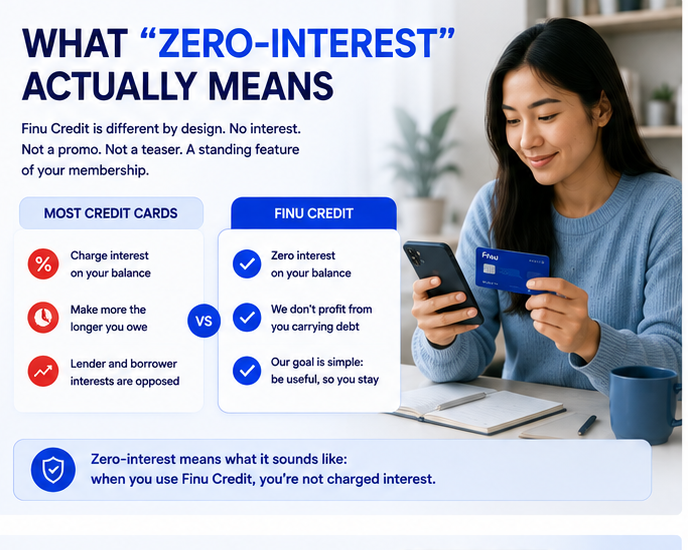
That's a meaningfully different foundation than how most consumer credit works. Traditional credit products make more money the longer you carry a balance and the more interest accrues — which means the lender's incentives and your incentives are pointed in opposite directions from the moment you use it. A membership-based model doesn't have that same built-in tension. The value to us isn't in you carrying debt longer; it's in Finu being useful enough that you want to stay a member.
Why zero, and not just lower
A fair question: why go all the way to zero instead of just offering a better rate than everyone else? A lower rate is still an easier, more familiar thing to build and explain.
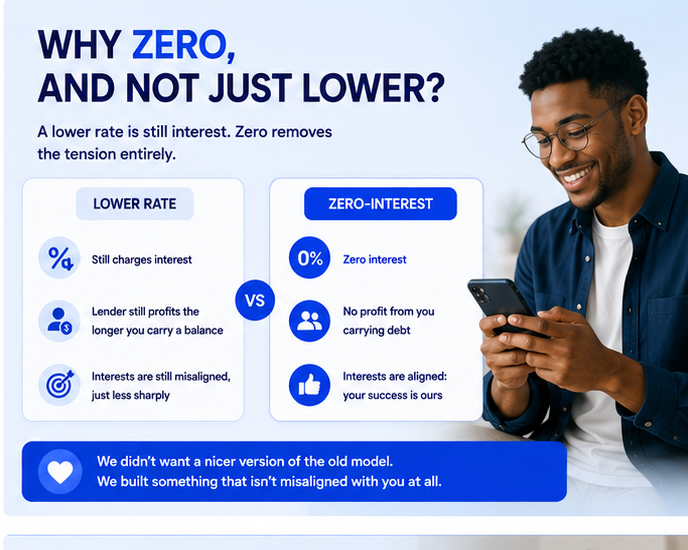
The honest answer is that a lower rate doesn't actually change the underlying incentive — it just softens it. Any interest-bearing product still makes more the longer a balance is carried, which means the lender's interests and the borrower's interests are still pointed in different directions, just less sharply than before. Zero removes that tension entirely instead of managing it. It's the difference between a product that's less misaligned with you and one that isn't misaligned with you at all. We wanted the second one, not a nicer version of the first.
How access works, at a high level
Rather than treating credit as a separate product you apply for in isolation — disconnected from everything else about your financial situation — access to Finu Credit is tied to your membership and informed by the same understanding of your finances that powers the rest of the app. That's a deliberate continuation of something covered earlier in this series: credit decisions made with a real, current picture of someone's situation tend to be more appropriate than ones made against a generic snapshot or a form filled out in isolation.
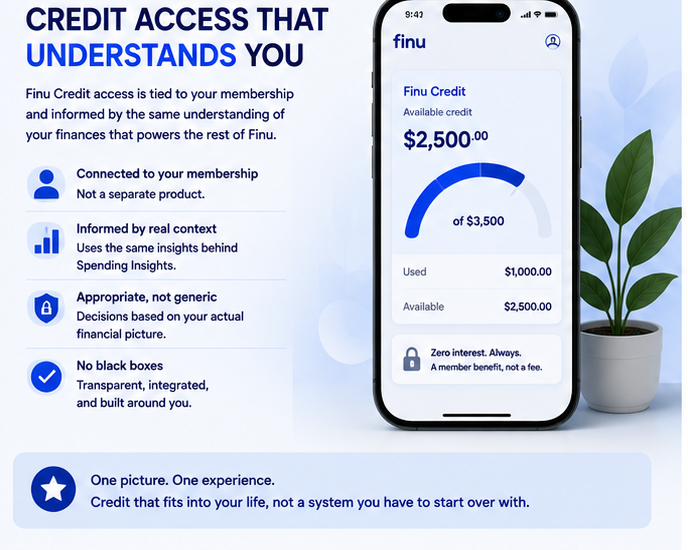
At a high level, that means access isn't a black box bolted onto an unrelated product — it's connected to the same context Finu already has, rather than starting over from nothing the way a standalone credit application usually does.
Why we're taking a different approach to consumer credit
Expensive consumer credit is expensive by design, not by necessity. High interest rates exist because lenders are pricing in risk and building in profit on top of it — a completely standard business model, and one that's created a lot of real harm for people who end up carrying a balance longer than they planned to, often not because of one bad decision but because interest compounds faster than most people expect.
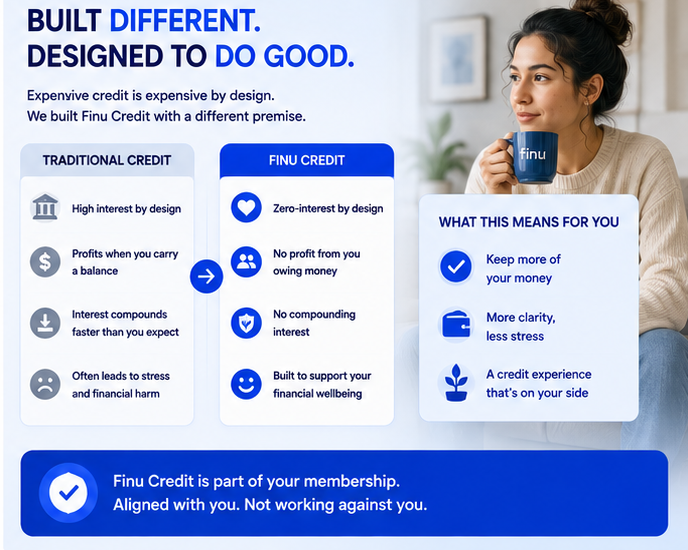
We didn't want to build a slightly cheaper version of that same model. We wanted to build something structurally different — where the cost of the product to us isn't tied to how long you owe money, so there's no built-in incentive on our side to hope you do. That's not a minor pricing tweak. It's a different starting premise for what a credit product is supposed to reward.
Why this fits naturally alongside AI, spending, and membership
This connects directly to something covered earlier in this series: the case for building spending, credit, and financial intelligence into one experience instead of separate, disconnected products. Finu Credit isn't a bolted-on feature competing for attention next to the rest of the app — it's an extension of the same relationship. The context that helps you understand your spending is the same context informing how credit fits into your situation, not a separate system re-evaluating you from scratch.
Membership is what makes that structure make sense. Instead of credit being a standalone product priced to extract value from a balance over time, it's part of what membership already includes — aligned with the same relationship, not working against it.
What this isn't
It's worth being upfront about what this isn't, too. Zero-interest doesn't mean unlimited, and it doesn't mean credit without any responsibility attached — access and terms still depend on your actual situation, the same way any credit product has to account for real financial circumstances. It also isn't a claim that credit is free to use in every sense; membership itself is the value exchange here, not a hidden fee standing in for interest under a different name. The specific mechanics of eligibility, limits, and terms are the kind of detail that belongs in your actual product and legal documentation, not in a blog post — this piece is meant to explain the idea plainly, not to serve as the terms themselves.
The natural next question: how does this work for you, then
Anyone hearing "zero-interest" reasonably wonders what the catch is, because in most of consumer finance, there is one. The honest answer is that the relationship doesn't depend on interest income to make sense — it depends on membership being genuinely worth staying for. That's a different business to be in than lending, and it's a deliberate choice: being good enough, consistently enough, that people want to stay members is a completely different incentive than hoping someone carries a balance a little longer than they meant to.
The underlying bet
The bet behind Finu Credit is the same one behind the rest of this series: that financial products work better when they're built around the person using them instead of around extracting the most value from them over time. Zero-interest credit built into membership is what that looks like applied to credit specifically — access that doesn't get more expensive the longer you need it, built on the same understanding of your situation that already powers everything else in the app.
That's the whole idea. Not cheaper debt. A different relationship with credit entirely.