

Understanding your money is one thing. Actually spending it — across countries, currencies, and everyday purchases — is another. Up until now, Finu has been excellent at the first part: helping people make sense of where their money goes. Finu Card is the natural next step, closing the gap between understanding your finances and actually using them, without leaving the experience that already understands your spending better than a stack of separate apps ever could.
Why a card, and why now
The honest starting point for this launch is a genuinely common frustration: the tools people use to understand their money and the tools they use to actually spend it have historically lived in completely separate places. You get insight from one app and friction from another — physical cards, separate banking apps, foreign transaction fees buried in the fine print, spending you can't easily connect back to the patterns you've actually been trying to change.
That disconnect gets expensive. Foreign transaction fees on most cards run between 1% and 3% of every purchase made abroad, with the 2026 average landing around 1.6%. That sounds small until you look at real trip spending: on $5,000 of purchases abroad, even a modest fee adds an extra $150 you never really agreed to, just for the privilege of using your own card in another currency. It's a quiet tax on exactly the kind of spending — travel, international purchases, cross-border subscriptions — that's become completely normal for how people actually live.
Finu Card exists to remove that disconnect, not by bolting a generic card onto the app, but by building the card as a genuine extension of the Finu experience — one where spending and understanding finally happen in the same place.
The experience: spend first, understand automatically
The design principle behind Finu Card is simple: every purchase should already speak the same language as the insights you're used to getting from Finu. There's no separate app to check, no export step, no reconciling one platform against another. A purchase happens, and it's immediately part of the same picture Finu has already been building about your spending patterns — instantly available to Spending Insights, instantly part of the story Finu can tell you about your money.
This isn't just a convenience. It changes what the card can actually do for you. Because Finu already understands your typical spending patterns, card activity that breaks from those patterns can be surfaced immediately and clearly — not buried in a monthly statement you'll skim two weeks from now, but folded directly into the conversation you're already having with Finu about your money.
Built for how people actually spend across borders
Global spending was a design requirement from day one, not an afterthought. Foreign transaction fees remain one of the most common — and most avoidable — costs in everyday card use, and the pattern has become entirely predictable: a small percentage tacked onto every international purchase, invisible at checkout, and expensive in aggregate by the time a statement arrives.
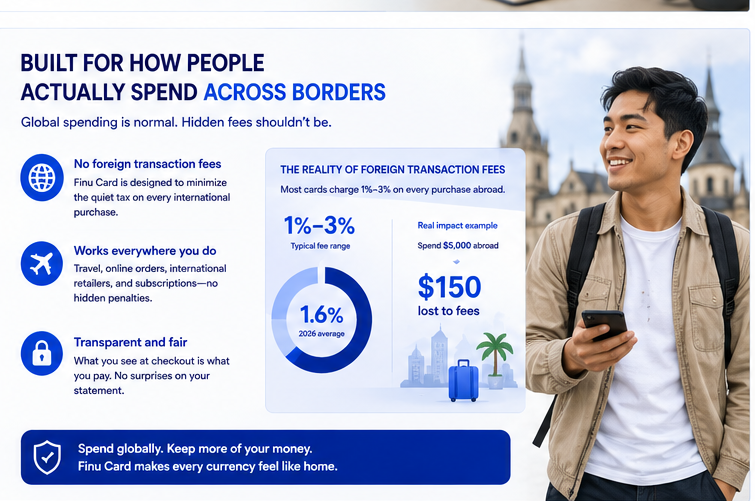
Finu Card is built around minimizing that quiet tax, so spending in a different currency doesn't come with a hidden penalty attached. Whether that's a purchase made while traveling, an online order from an international retailer, or a subscription billed in a currency that isn't your own, the goal is the same: spending should work the way people actually live, not the way legacy card infrastructure assumed they would a decade ago.
Rewards that reflect real spending, not just categories
Card rewards programs have a well-known blind spot: they tend to reward the categories issuers want to encourage, not necessarily the categories that reflect how a given person actually spends. Finu Card takes a different starting point, using the same understanding of individual spending patterns that already powers Spending Insights to make rewards feel relevant to the person actually holding the card, rather than a generic points structure applied uniformly across every user regardless of their habits.
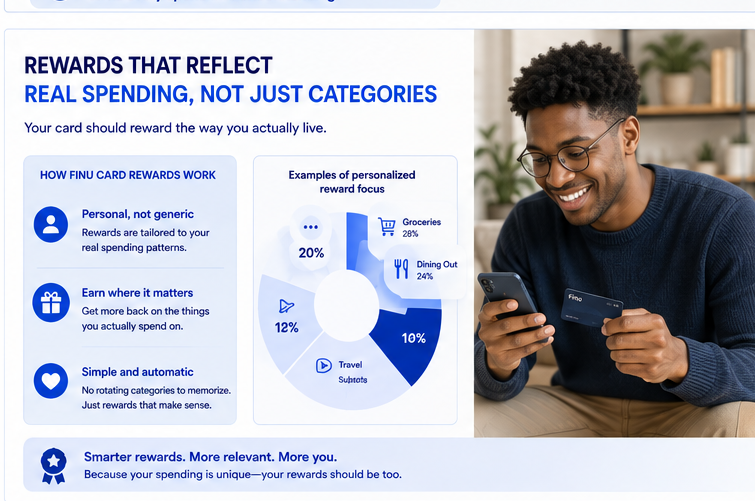
The result is a rewards experience that's less about memorizing which category multiplier applies this quarter, and more about the card quietly working in the background, the same way the rest of Finu already does.
Card activity as part of your broader financial context
The most meaningful shift Finu Card introduces isn't really about the physical or digital card itself — it's about what happens after a purchase. Every transaction made on Finu Card becomes part of the same ongoing financial picture Finu has already been building. That means a purchase abroad, a subscription renewal, or an unusual one-off expense isn't just a line item to reconcile later. It's immediately woven into the patterns, trends, and answers Finu already gives you — the same way a forgotten subscription or a spending spike would show up in Spending Insights.
Take an anonymized example. A Finu user we'll call Owen used Finu Card during a two-week work trip abroad. Rather than discovering the full cost of that trip weeks later on a separate statement, spending was visible in real time, already grouped against his typical baseline, with the international purchases clearly flagged as part of a short, bounded travel period rather than folded anonymously into his regular monthly categories. When he got back, there was no reconciliation exercise — just a clear, already-assembled picture of what the trip actually cost, sitting inside the same app he'd use to ask about anything else in his finances.
One experience, not two
The bigger idea behind Finu Card is that spending and understanding shouldn't be two separate relationships with two separate tools. For most people, the two have always been artificially split — a card from one provider, insight from an entirely different app, with the burden of connecting the two left entirely up to the user.
Finu Card removes that split. It's not a new product bolted onto Finu. It's Finu extended into the moment of actually spending money, so that everything you've come to expect from Finu — the clarity, the pattern recognition, the plain-language explanations — is present exactly when it's most useful: right as the money leaves your account, not weeks later when you're trying to remember why.