

Nobody makes a single big decision that determines their financial life. There's rarely one dramatic purchase, one reckless month, one moment where everything tips. What actually shapes someone's financial trajectory is thousands of small, forgettable transactions — a coffee, a subscription renewal, a delivery fee — compounding quietly over months and years until they add up to a story.
Transaction data is one of the few tools that can actually see that story as it forms, rather than after the fact. Looked at carefully, and combined with what research already tells us about spending psychology, recurring transaction patterns turn out to be a remarkably honest record of how people actually manage money — often more honest than how people describe their own habits.
Budgeting behavior is more reactive than it looks
Traditional personal finance advice treats budgeting as a proactive discipline: set a plan, follow the plan, adjust the plan monthly. Transaction data tells a messier, more human story. Spending doesn't move in response to a plan nearly as often as it moves in response to a trigger — a low-balance notification, a big bill landing, a stretch of stress at work.
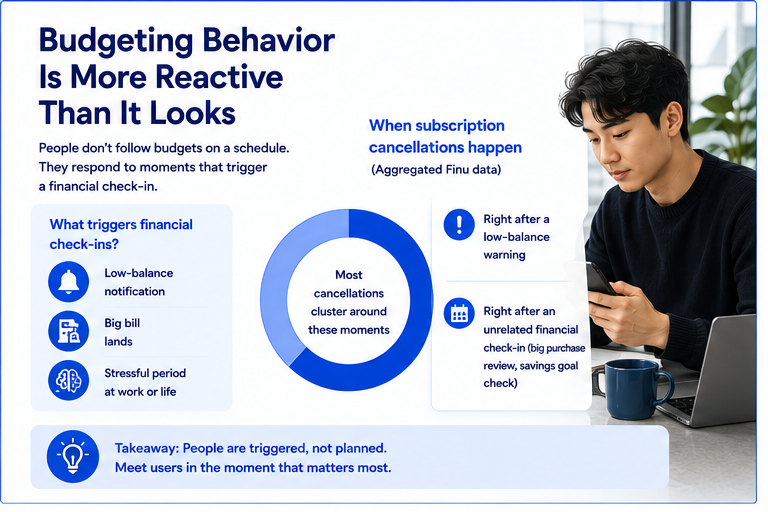
This shows up clearly in aggregated Finu data. Across anonymized accounts, subscription cancellations cluster tightly around two kinds of moments: right after a low-balance warning, and right after an unrelated financial check-in, like reviewing a big purchase or checking progress on a savings goal. People rarely audit their recurring charges as a scheduled task. They audit them when something else has already put money on their mind.
This lines up with what the broader research on financial decision-making tends to find: much of everyday money behavior is triggered, not planned. A dashboard full of static budget categories assumes people will check in on a schedule. In practice, most people check in when something jolts them into it — which is exactly the moment when a product actually has the chance to be useful, rather than just accurate.
Subscription creep is quiet, structural, and remarkably consistent
Nearly everyone underestimates how many active subscriptions they're carrying. This isn't a personal failing so much as a predictable outcome of how subscription products are designed — sign-up is a single deliberate action, but cancellation requires remembering the subscription exists in the first place, then actively deciding to end it. One of those steps gets a notification. The other doesn't.
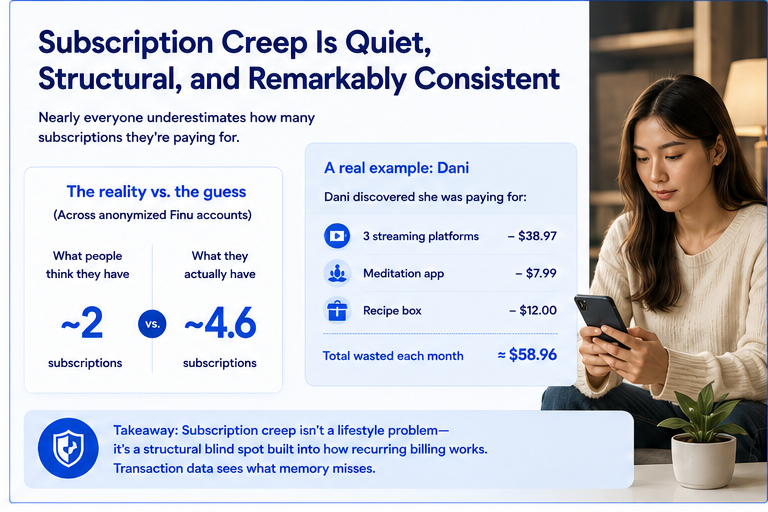
Anonymized Finu account data reflects this pattern clearly and consistently: the average number of active recurring charges per user runs noticeably higher than what people tend to guess when asked to estimate their own subscription load. A Finu user we'll call Dani is a good example of how this plays out in practice — she discovered she was paying for three streaming platforms, a meditation app she'd used twice, and a recipe box she thought she'd already cancelled. None of these individually looked alarming. Together, they were quietly costing her close to sixty dollars a month for services she wasn't using.
What's notable in the data isn't just that this happens — it's how consistently it happens across very different account profiles, income levels, and spending styles. Subscription creep isn't really a lifestyle issue. It's closer to a structural blind spot built into how recurring billing works, and transaction data is one of the only tools well-suited to catching it, simply because it doesn't rely on anyone remembering anything.
Lifestyle inflation shows up gradually, in small category shifts
Lifestyle inflation — the tendency for spending to expand quietly as income grows — is notoriously hard for people to self-diagnose, because it rarely feels like a single decision. Nobody wakes up and decides to upgrade their entire spending pattern. It happens one small substitution at a time: the cheaper grocery run becomes a slightly nicer one, the occasional takeout becomes a routine, the budget option quietly stops being considered at all.
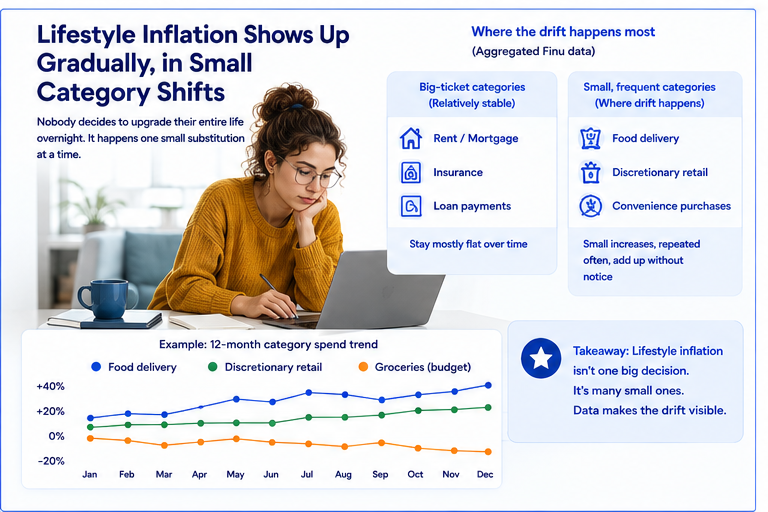
Transaction data is uniquely good at making this visible, because it captures category-level drift over time in a way that's almost invisible to someone living through it month by month. Aggregated patterns across Finu accounts show this drift concentrated less in big-ticket categories, which tend to stay relatively stable once set (rent, insurance, loan payments), and more in the smaller, more frequent categories — food delivery, discretionary retail, convenience purchases — where small increases repeat often enough to add up without ever registering as a single noticeable change.
This matters because lifestyle inflation is genuinely difficult to address through willpower alone, precisely because it doesn't feel like a decision in the moment. Seeing the category-level drift laid out — not as a lecture, but as a simple "here's what actually shifted" — tends to be far more effective than generic advice to "spend less," because it points at something specific and real rather than asking someone to feel generally guiltier.
Discretionary spending carries more emotional weight than financial weight
One of the more consistent findings across both academic research and aggregated transaction data is a gap between how much a category actually costs someone and how much anxiety it produces. Discretionary categories — food delivery, subscriptions, one-off "treat" purchases — tend to make up a modest share of total spending, often in the high single digits as a percentage of income, but they show up disproportionately often in the moments right before someone checks their balance anxiously or reaches out with a question about a spending spike.
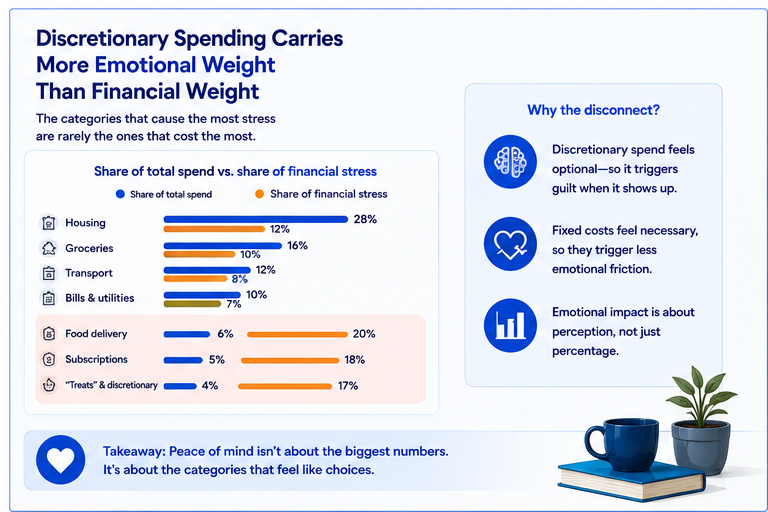
This gap between financial impact and emotional impact is genuinely useful to understand, because it suggests a lot of financial stress isn't proportional to actual risk. It's concentrated in categories that feel indulgent or easily judged, regardless of whether they're the thing actually threatening someone's financial stability. Transaction data, read carefully, can help separate the two — showing someone clearly that the categories causing the most guilt aren't always the categories doing the most damage, and vice versa.
Overspending is usually a short event, not a permanent shift
Perhaps the most reassuring pattern in aggregated transaction data is also one of the most consistently underestimated by the people living through it: most periods of spending meaningfully above baseline are short, contained to a week or two, and tied to an identifiable cause — a move, a big one-off purchase, a stretch of bills landing close together. Sustained, unexplained drift upward over months is far less common than the short, bounded spike.
This runs counter to a private narrative a lot of people carry, which is that a rough month signals a deeper problem with self-control or financial habits. Looking at transaction data across many accounts over time tells a calmer story: the far more typical pattern is a temporary spike followed by a return to baseline. Financial anxiety, in these cases, often comes less from the spike itself and more from a fear that the spike represents the new normal — a fear that transaction history, viewed with enough context, is well positioned to either confirm or quietly put to rest.
What this means for how spending should actually be understood
Put these patterns together and a clear picture emerges: everyday money decisions aren't really governed by grand plans or single moments of failure or success. They're governed by small, repeatable, often invisible patterns — reactive check-ins rather than scheduled reviews, quiet subscription creep rather than dramatic overspending, gradual category drift rather than sudden lifestyle change, short contained spikes rather than sustained decline.
Transaction data is one of the few tools capable of surfacing these patterns honestly, because it doesn't depend on memory, self-assessment, or willpower. It just shows what actually happened. The real value isn't in the data itself, though — it's in translating that data into something a person can actually use: not a bigger spreadsheet, but a clear, specific, honest answer to the question underneath almost every spending concern, which is usually some version of "is this okay, and if not, what do I actually do about it?"