

Open five finance apps on your phone and you'll find five different versions of you. The budgeting app knows your spending categories. The rewards app knows your card activity. The credit app knows your score and nothing else. None of them are talking to each other, and none of them are talking to the version of you that actually exists — the one whose spending, credit, and rewards are all part of the same financial life, not three separate ones.
That fragmentation isn't a minor inconvenience. It's the reason so much financial advice ends up generic: no single product has enough of the real picture to say anything specific. We didn't want to build another piece of that puzzle. We wanted to build the thing that holds the whole picture at once.
The other model: point solutions
The standard approach in fintech is to build one thing and build it well. A budgeting app that categorizes spending. A cashback app that optimizes rewards. A credit product that evaluates eligibility. Each one genuinely good at its single job, and each one almost entirely blind to everything outside it.
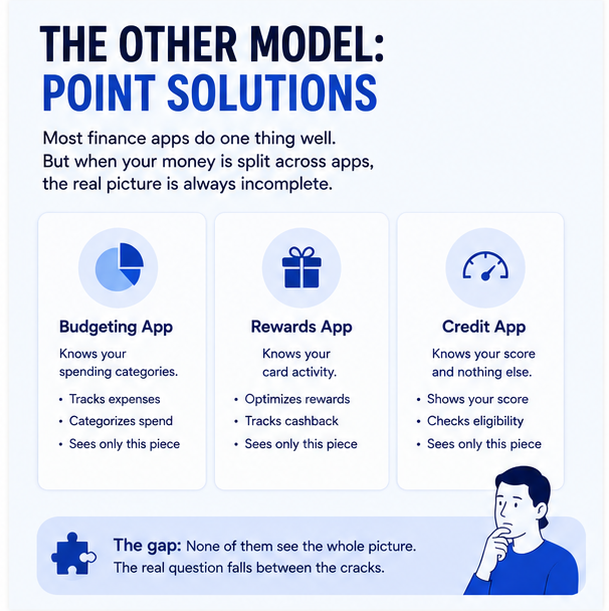
That specialization isn't wrong, exactly — it's just incomplete in a way that only shows up when you actually try to make a real decision. A rewards app can tell you which card earns more cashback on groceries. It has no idea whether carrying a balance to get there costs you more in interest than the rewards are worth. A credit app can tell you your score. It has no idea whether taking on more credit right now actually fits what's happening in your spending this month. Each product answers its own narrow question perfectly and the real question — the one that actually crosses all three — falls into the gap between them.
Money isn't actually separate the way apps treat it
Think about the decisions people actually make with money. Should I put this on a card that earns rewards, or pay cash to avoid the risk of carrying a balance? Does taking this credit offer make sense given everything else going on this month? Is this purchase actually fine, or does it push something else out?
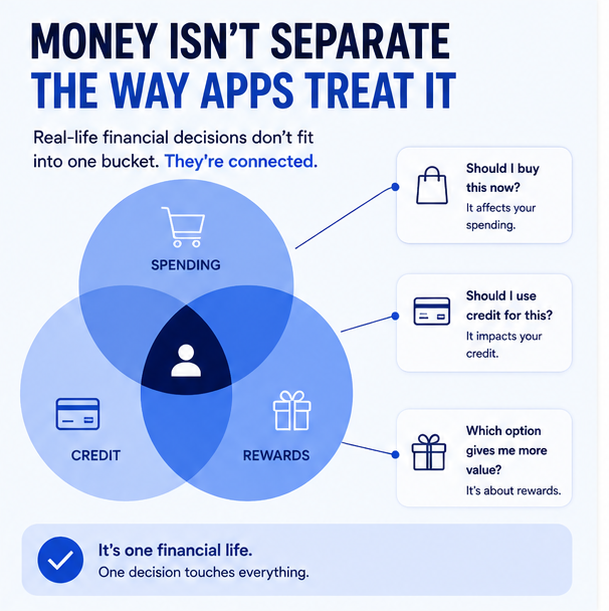
None of those are single-category questions. They're spending questions and credit questions and rewards questions at the same time, because that's how money actually works — it's one connected system, not three separate ledgers. Splitting it across separate apps doesn't reflect that reality; it just outsources the job of connecting the dots back to the person, who now has to manually synthesize what four different apps each know a quarter of.
What that gap actually costs, in practice
Picture how this plays out for someone real. They're deciding whether to put a big purchase on a rewards card or pay it off in cash. The rewards app tells them which card earns the most points. It doesn't know they're already carrying a balance elsewhere, or that spending has been tighter than usual this month. So they take the rewards, the balance grows, and the interest quietly outweighs whatever points they earned — a worse outcome than doing nothing, arrived at by following good advice from a tool that just didn't have the rest of the picture.
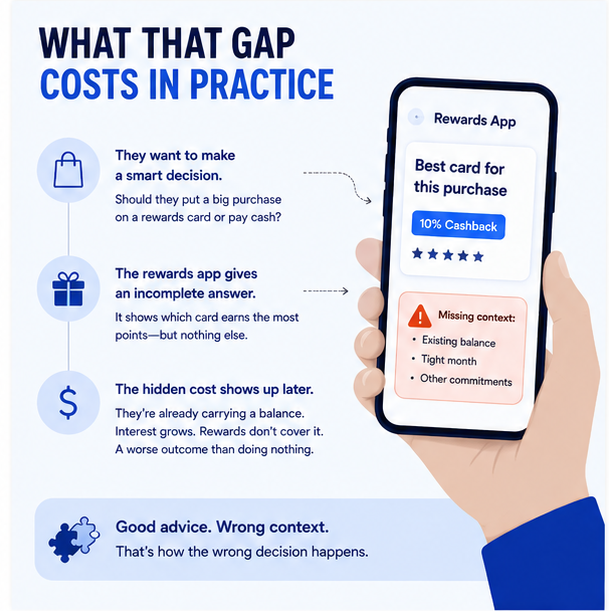
Nobody involved did anything wrong. The rewards app gave an accurate answer to the only question it was built to answer. The problem was that the real decision needed three apps' worth of context to get right, and none of those three apps had access to what the others knew. That's not a hypothetical edge case — it's what happens by default whenever spending, credit, and rewards are treated as separate products instead of separate facets of the same ongoing situation.
What "one relationship" actually means
This is where everything else in this series connects. The context and memory covered earlier — the ongoing understanding of your actual situation, not just a snapshot — only stays useful if it's the same understanding informing every kind of question you ask, not a fresh, shallow one rebuilt from scratch by whichever product happens to be open.
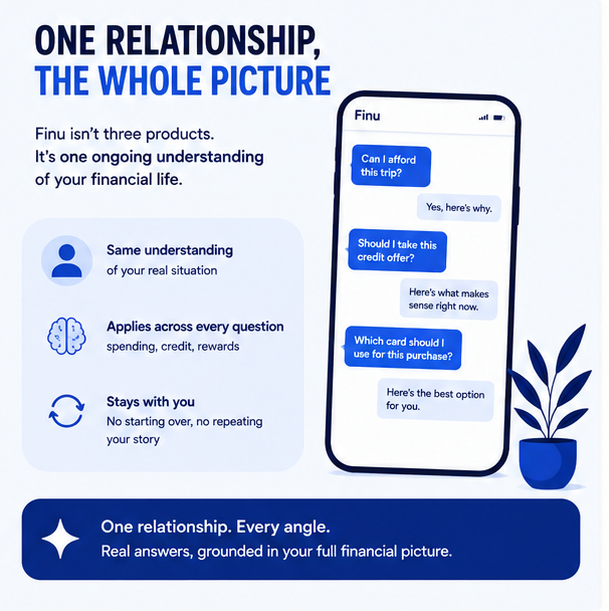
"One relationship" means Finu isn't starting over every time the topic shifts from spending to credit to rewards. The same grounded picture of your situation that answers "can I afford this trip" is the same picture informing whether a particular credit decision makes sense right now, or which spending patterns would actually benefit from a different rewards structure. It's not three products sharing a login. It's one ongoing understanding, applied across whatever question you're actually asking.
Why this matters more for credit than almost anything else
Rewards optimization is a nice-to-have. Credit is not — a decision made with a full, honest picture of someone's actual situation is a fundamentally different thing than a decision made against a generic score and a form. Traditional credit offers are built to evaluate a profile in isolation, disconnected from what's actually happening in someone's spending this month, this week, right now.
That disconnect is exactly the kind of gap this series has been about closing. The same principle from earlier pieces — real answers grounded in real, current context instead of generic advice built for an average that doesn't describe anyone — applies just as much here. A credit decision informed by an actual, current financial picture has a better shot at being genuinely appropriate for that person's situation than one built on a snapshot that's already out of date by the time it's used.
Rewards that reflect how you actually spend, not a generic category
The same logic applies on the rewards side, just with lower stakes. A generic rewards structure optimizes for an average spender who doesn't exist. Someone whose real spending patterns are already understood — the categorization and pattern work from earlier in this series — can be met with something that actually reflects how they spend, instead of a flat rate built for a hypothetical "typical" user everyone gets the same version of.
Why not just be excellent at one thing instead
This is worth taking seriously rather than waving away. There's a real trade-off in refusing to specialize — a company that does only credit, or only rewards, can go deeper into that one thing than a company splitting attention across all three. That's a genuine cost, not a fake one.
We made the trade anyway, because the depth a single-purpose product gains is depth in isolation — and isolation is exactly the problem we were trying to solve. A slightly less specialized credit feature that's informed by your actual, current spending context is more useful to most people than a maximally specialized one that has to guess at everything else about your situation. We'd rather be genuinely useful across your whole financial life than maximally deep in one narrow slice of it, disconnected from the rest.
One picture, not three logins
None of this was about cramming unrelated features into one app for convenience's sake. It was about recognizing that spending, credit, and rewards were never actually separate to begin with — they only look separate because most products were built around organizational convenience rather than how people's financial lives actually work.
Building it as one experience means the understanding Finu has of you doesn't reset every time the question changes shape. It's not three products that happen to share a login. It's one relationship, carried across every kind of question you'd ever actually need to ask about your own money.