

Open your banking app right now. Go on. Scroll through last month.
Somewhere between the coffee shop you forgot you went to twice, the subscription you swear you cancelled, and the grocery run that looked suspiciously like a Target run — there's a real answer in there about your money. You just can't see it. Not because the data isn't there, but because there's too much of it, and none of it is speaking your language.
Scroll far enough and you'll hit the same wall most people hit: forty, sixty, sometimes a hundred-plus line items in a single month, each one technically "information," none of them individually telling you anything. "$14.02, Tuesday." "$212.87, Thursday." On their own, they're just numbers with timestamps. Stacked together, they're supposed to represent your entire financial life — but nobody has time to read a hundred receipts and mentally build a spreadsheet out of them.
That's the actual problem Finu is built to solve. Not "give you more numbers." You have plenty of those already, sitting untouched in an app you rarely open past the balance screen. The problem is turning hundreds — sometimes thousands — of individual transactions into the one thing you actually came for: a clear answer you can act on.
Here's how that happens.
Step one: raw data isn't information
A transaction, on its own, is basically just a timestamp and a number. "$47.32, Tuesday, unknown merchant code." That's not insight — that's noise wearing a decimal point.
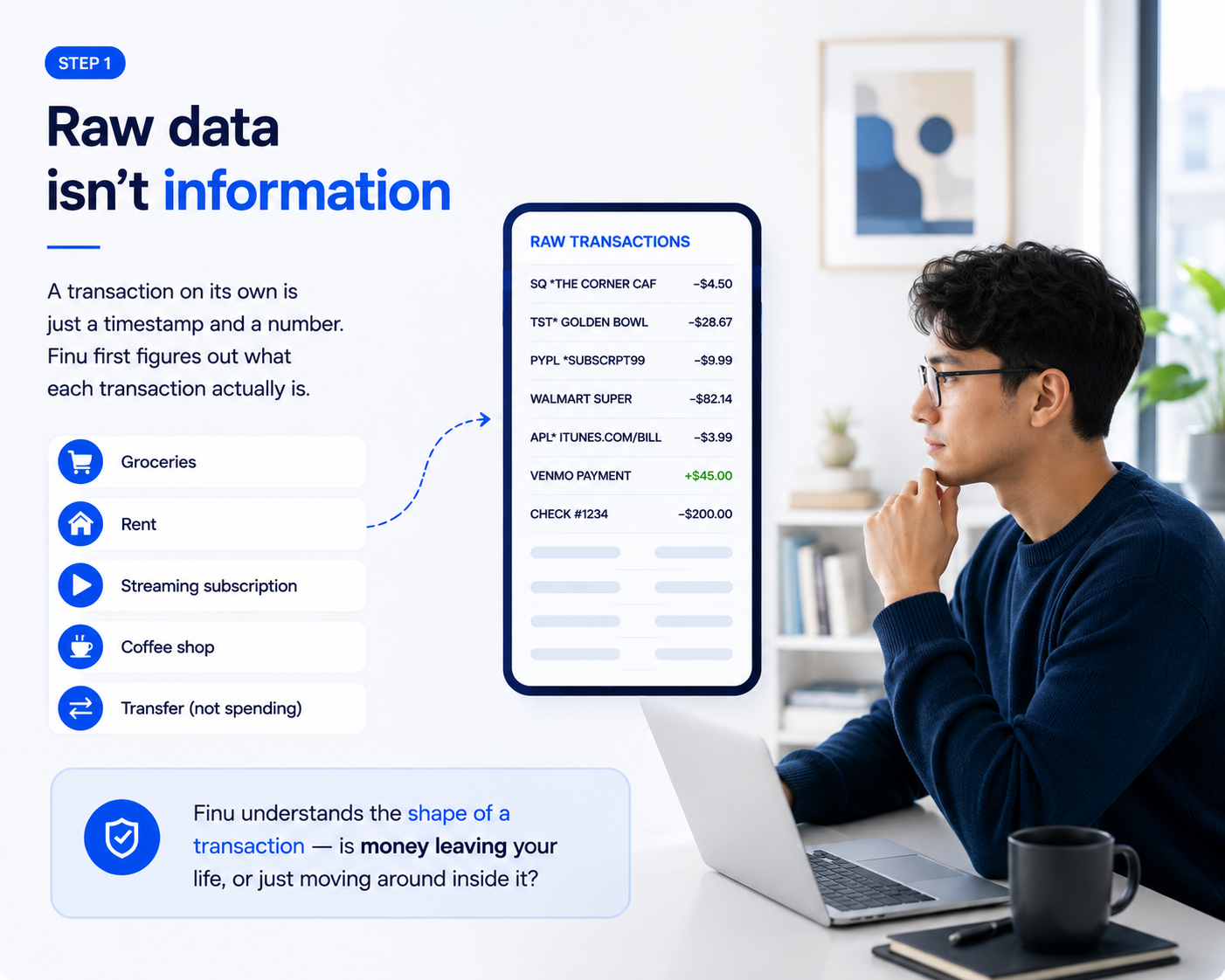
Before Finu can tell you anything useful, it has to figure out what each transaction actually is. Groceries. Rent. That one streaming service you keep meaning to cancel. This is categorization, and it sounds simple until you remember that merchant names on receipts are, charitably, a mess. "SQ THE CORNER CAF" is a coffee shop. "TST GOLDEN BOWL" is dinner. "PYPL *SUBSCRPT99" could be almost anything. No human wants to manually sort that every month — and honestly, no human should have to.
It gets messier than naming, too. A refund isn't spending. A transfer between your own accounts isn't spending. Splitting a bill with a roommate and getting paid back isn't quite spending either, even though it shows up looking exactly like a normal charge. Getting categorization right means understanding the shape of a transaction, not just its label — is this money leaving your life, or just moving around inside it?
Step two: patterns you'd never catch by scrolling
One transaction tells you almost nothing. A hundred transactions, looked at together, tell you everything.
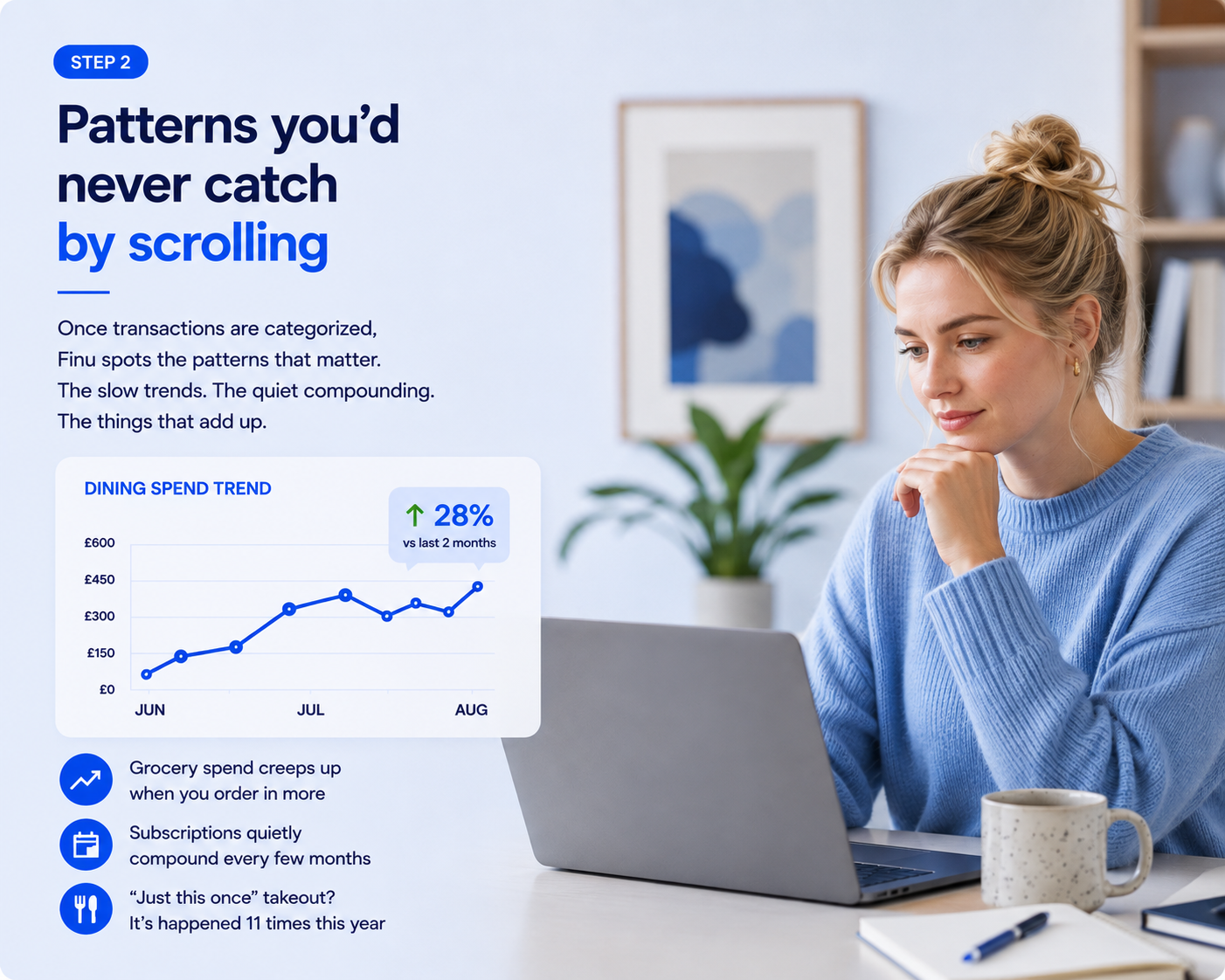
This is where it gets genuinely useful. Once your spending is sorted into real categories, patterns start showing up that are basically invisible when you're just scrolling a feed: your grocery spend creeps up every time you order in more, your subscriptions quietly compound every few months, your "just this once" takeout order has, in fact, happened eleven times this year.
Say your dining spend crept up gradually over a couple of months without any single purchase looking alarming on its own — no big splurge, just a few extra orders here and there. Scrolling your transaction list, you'd probably never notice. Looked at as a trend instead of a list, it's obvious almost immediately.
Humans are bad at spotting slow trends. We notice the one big purchase, not the small one that repeats. We remember the impulse buy for months; we forget the small charge that's quietly renewed itself nine times. Finu is built to catch the second kind — the stuff that adds up quietly and never sends you a notification of its own, because no single instance of it ever looked like a problem.
Step three: making it a conversation, not a spreadsheet
Here's the part that actually changes how this feels day to day. All that categorized, pattern-spotted data doesn't do much good sitting in a dashboard you have to go dig through. So instead of handing you a report, Finu is built to just answer you.

Ask "can I afford a weekend trip this month?" and instead of a wall of charts, you get an actual answer — grounded in your real spending, not a generic rule of thumb. Ask "why is my balance lower than usual?" and you get the actual reason, not seventeen line items to reverse-engineer yourself. Ask "am I spending more on food than usual?" and the answer doesn't come with homework attached — it just tells you, plainly, whether that's true and by roughly how much.
That's the shift: from here's your data to here's your answer. The categorization and pattern work happen quietly in the background; what you actually experience is closer to texting a friend who happens to have perfect recall of your bank statement and zero judgment about what's on it.
Why this is harder than it sounds
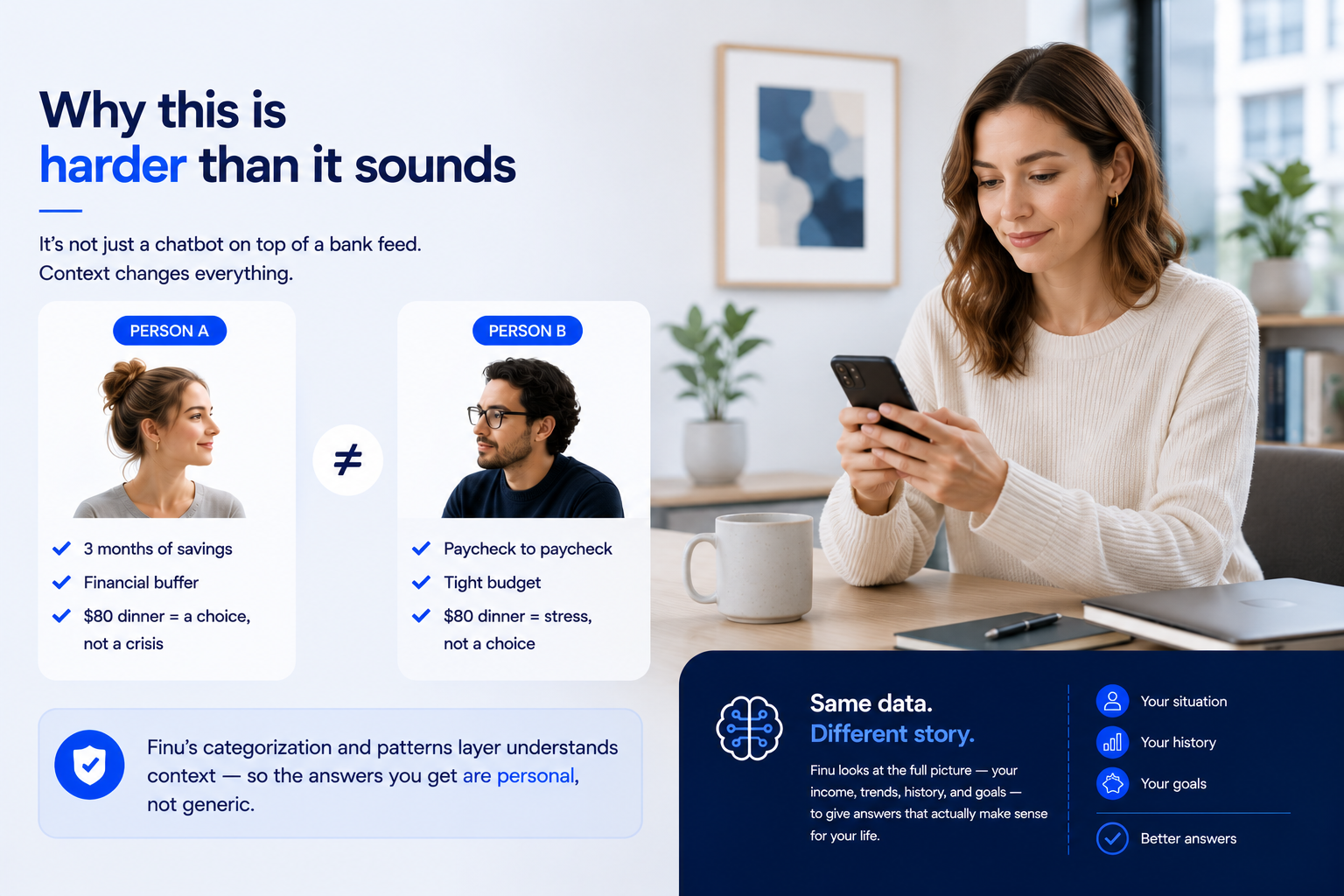
It's worth pausing on why this isn't just "add a chatbot on top of a bank feed." Two people can have identical raw transaction lists and completely different real situations — one has three months of savings behind them, the other is living paycheck to paycheck. The same $80 restaurant charge means something different depending on everything around it.
That means the categorization and pattern layers can't just sort transactions into neat little buckets and call it done. They have to hold onto the context of why a pattern matters for this specific person, so that by the time a question reaches the conversational layer, the answer isn't generic — it's already shaped around a real financial life, not a hypothetical average one.
More data was never the goal
It's tempting to think a good finance app is the one that shows you the most. More charts, more breakdowns, more numbers on the screen, more colors in the pie chart. In practice, that's usually the opposite of helpful — it just moves the hard work of interpretation back onto you, which is the exact work you were trying to hand off in the first place. A dashboard with forty widgets isn't clarity. It's just a different kind of noise, dressed up nicer.
The real goal is compression, not expansion: take everything that happened with your money this month and boil it down to the one thing you need to know right now. Categorization and pattern recognition are how Finu understands your transactions. Conversational answers are how it hands that understanding back to you — as something you can actually use, not something you have to decode.
Think of it less like a report and more like a really good summary from someone who already did the reading. You don't need to see every line of the source material to trust the takeaway — you just need the takeaway to be right, and to actually apply to you specifically.
Thousands of transactions in. One useful answer out. That's the whole idea.