
Every generation gets accused of "doing money differently." Usually it's an exaggeration. This time, the data actually backs it up.
Gen Z isn't just using financial products at a different rate than the generations before them — they're using different products, for different reasons, held to a different bar of trust, inside a different economic reality. Put those pieces together and you get something more interesting than a demographic quirk. You get a preview of where financial products are headed for everyone, whether the industry is ready or not.
They adopted AI in finance faster than anyone predicted — and trust it less than you'd expect
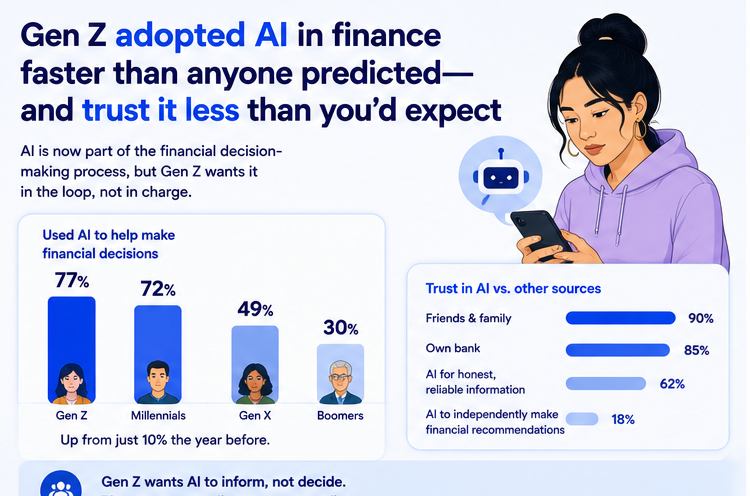
Start with the headline number: 55% of Gen Z and millennials say they used AI to help make financial decisions, up from just 10% the year before. Within that, Gen Z shows the highest adoption rate of any generation at 77%, ahead of millennials at 72%, Gen X at 49%, and boomers at 30%.
That's a real, structural shift — not a slow creep, a step change in a single year. But adoption and trust are not the same thing, and this is where it gets genuinely interesting. Only 18% of US adults say they'd trust AI to independently make financial recommendations, even though 78% report using AI-powered tools. Trust in AI for honest, reliable information sits around 62%, well below the 90% people place in friends and family and the 85% they place in their own bank.
Read those two data points together and a clear pattern emerges: Gen Z wants AI in the loop, not in charge. They're comfortable letting a tool surface information, flag a pattern, or draft an option. They're far less comfortable letting it make the call. Products that treat AI as a co-pilot rather than an autopilot are working with the grain of this generation, not against it.
Credit looks completely different for this generation — and it isn't going well
If there's one place where "Gen Z does money differently" stops being a lifestyle observation and starts being a real financial risk, it's credit.
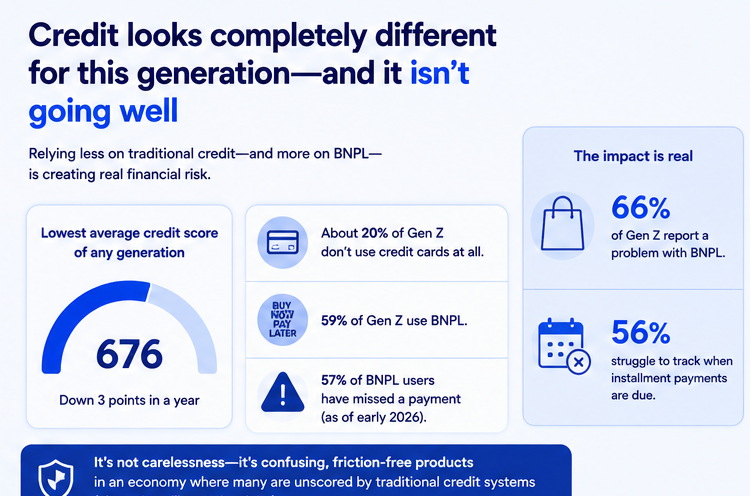
Generation Z now holds the lowest average credit score of any generation, at 676 according to FICO — down three points in a single year. Part of the reason: about 20% of Gen Z say they don't use credit cards at all, a likely driver of their heavier reliance on Buy Now, Pay Later loans. And BNPL has moved from novelty to habit fast. Fully 59% of Gen Z say they use BNPL, and 57% of those users have missed a payment as of early 2026.
The consequences aren't evenly distributed either. Gen Z is the group most likely to report a problem with BNPL, at 66%, and their most common complaint is that it caused them to overspend. More than half — 56% — say they struggle to track when installment payments are actually due.
This isn't a generation being careless. It's a generation using the tools available to them — tools explicitly marketed as friction-free — inside an economy where many financial products are, by Snap Finance's own framing, "designed to be confusing," even as the CFPB estimates roughly 25 million U.S. adults are effectively unscored by traditional credit systems. The friction was removed from the purchase. It didn't disappear — it just moved downstream, to the moment the payment is due and nobody remembered to check.
They're pulling back on spending, not recklessly chasing it
The popular image of Gen Z as impulsive spenders doesn't hold up well against the actual numbers. PwC's analysis of nearly a million consumer transactions found Gen Z reduced overall spend by roughly 13% between January and April 2025, concentrated in apparel, accessories, and electronics. Going into the following holiday season, Deloitte found Gen Z shoppers planned to cut holiday spending by 34% year-over-year — more than double the pullback seen among millennials — with 62% expressing anxiety about higher prices.
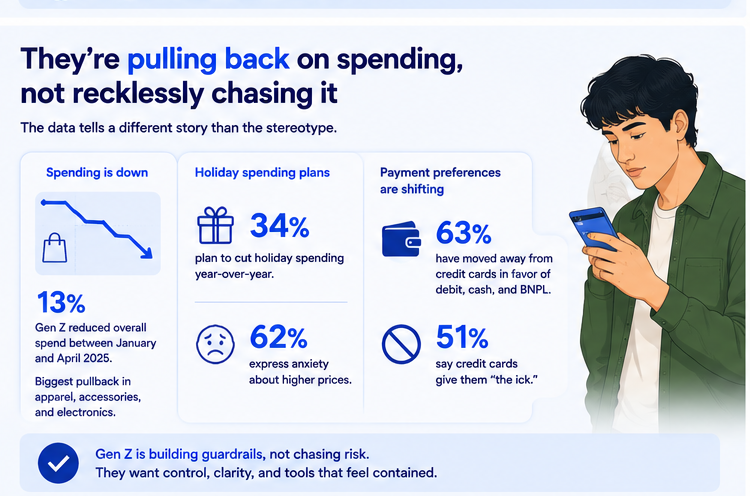
Payment preferences have shifted in the same direction, away from open-ended credit and toward tools that feel more contained. Cash App Afterpay's 2025 study found 63% of Gen Z have moved away from credit cards in favor of debit, cash, and BNPL, and 51% say credit cards give them "the ick." That's not a generation chasing risk. It's a generation trying to build guardrails for itself, even if the tools they're reaching for don't always cooperate.
They expect the product to keep proving itself
Loyalty, for Gen Z, isn't inherited from a brand name the way it sometimes was for their parents. Gen Z expects banks to evolve constantly, with 47% rating regular updates and new features as a genuine trust factor. They're also increasingly happy to get financial services from somewhere other than a bank entirely — embedded finance is rising, with Gen Z favoring access to banking features through non-bank platforms like ride-share or gaming apps.
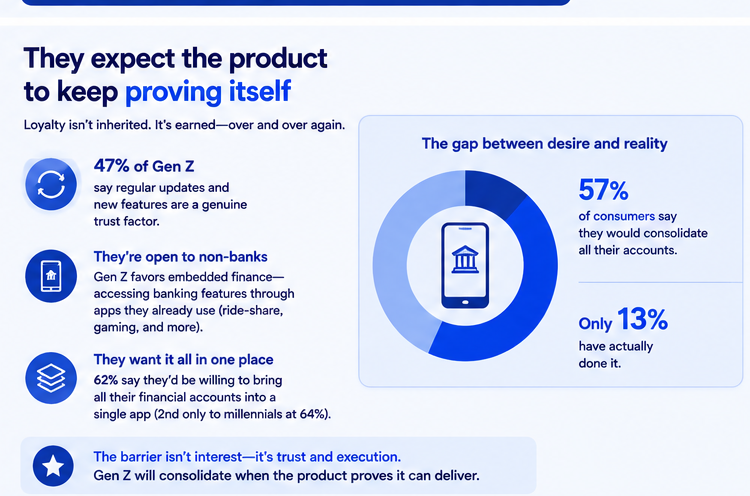
The demand for consolidation is high too: 62% of Gen Z say they'd be willing to bring all their financial accounts into a single app, second only to millennials at 64%. But there's a gap between desire and reality here that matters for anyone building product — only 13% of consumers who say they want this have actually done it, despite 57% saying they would. That gap is an opportunity, not a dead end. It suggests the barrier isn't interest, it's trust and execution.
What this means for how financial products need to evolve
Pull these threads together and a fairly clear brief emerges for anyone building financial products for this generation — or, increasingly, for everyone, since Gen Z's preferences tend to become the default a few years later.
Assistive, not autonomous. The appetite for AI is real, but it's an appetite for a second opinion, not a decision-maker. Products that explain their reasoning and leave the final call visibly in the user's hands will earn more trust than ones that quietly act on their behalf.
Built-in guardrails around credit tools. Given how many Gen Z users are already missing BNPL payments and struggling to track due dates, there's a clear opening for financial products that make repayment schedules impossible to lose track of — not as a compliance afterthought, but as a core feature.
Consolidation that's actually easy, not just promised. The demand to bring everything into one place is there. The execution gap is the opportunity. A product that makes consolidation genuinely frictionless, rather than technically possible, is solving a problem people have already told you they have.
Constant, visible evolution. For a generation that treats "does this app keep getting better" as a trust signal in itself, static products lose ground even if nothing about them has gotten worse. Standing still reads as falling behind.
None of this is really about Gen Z being unusual. It's about Gen Z being early — early to distrust default settings, early to demand transparency over authority, early to want a financial product that acts less like a ledger and more like something that's actually paying attention. The financial products that take that seriously now won't just be building for Gen Z. They'll be building for where everyone else is headed next.