

Put two people's finances side by side — same balance, same monthly spend, same categories — and you still won't know anything true about either of them until you know where they live.
$50 on groceries means something completely different depending on the cost of living around it. A missed bill carries different weight depending on what the penalty actually is where you are. Even the idea of a "paycheck" assumes a cadence — weekly, biweekly, monthly — that isn't universal at all. Building Finu for one country would have been hard enough. Building it for people across more than 40 of them meant a lot of assumptions we didn't even realize we were making had to get found and taken apart, one by one.
This isn't a story about expansion. It's a story about what it actually takes to make "personalized" mean something real when "personal" has to account for an entirely different financial reality depending on where the question is being asked from.
One product, wildly different financial realities
Everything covered earlier in this series — context, memory, retrieving the right facts before answering — depends on understanding what's normal for a given person. That's manageable when normal is relatively consistent. It gets a lot harder when normal varies by an order of magnitude depending on geography.
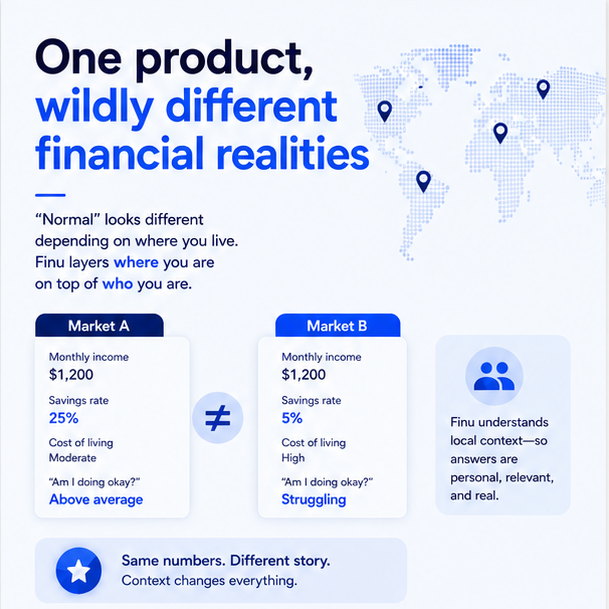
A savings rate that would be impressive in one market is barely survivable in another, for reasons that have nothing to do with anyone's financial habits and everything to do with cost of living, wage structures, and what a "safety net" even looks like locally. If Finu answered every "am I doing okay?" against one universal benchmark, it would be quietly wrong for most of the people asking it — technically consistent, actually useless. Personalization had to mean layering where on top of who, not just accounting for one and assuming the other.
Currency is the easy part — mostly
Handling multiple currencies sounds like the obvious challenge, and it's real, but it's also the part that's most solvable with careful engineering rather than judgment calls. Numbers need to display the way people actually expect to read them — decimal points and thousands separators aren't universal, currency symbols go in different places, and rounding conventions differ enough that getting it wrong looks sloppy even when the math is technically correct.
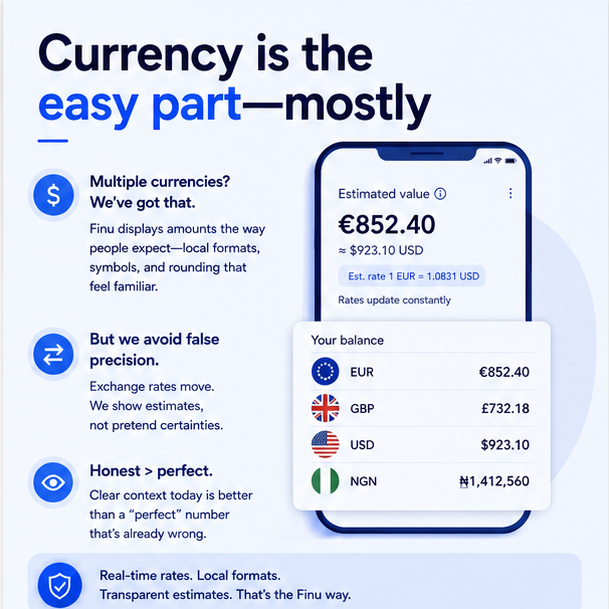
The less obvious part is resisting false precision. Exchange rates move constantly, and it's tempting to convert everything into one reference currency for the sake of tidy comparisons. But a number that looks exact and isn't is worse than being honest about the fuzziness — someone planning around a converted figure that shifted by the time they acted on it isn't being served by fake precision, they're being set up to be wrong. Where currency conversion matters, it needs to be clearly framed as an estimate, not quietly presented as fact.
Financial infrastructure isn't the same everywhere
This is the one that doesn't show up until you're deep into it. The categorization and pattern work from earlier in this series assumes a certain richness of transaction data — but how much detail is even available depends heavily on the banking infrastructure of a given market. Some places have mature, standardized systems that hand over clean, well-labeled transaction data. Others don't, and the same categorization confidence just isn't achievable from thinner, messier source data.
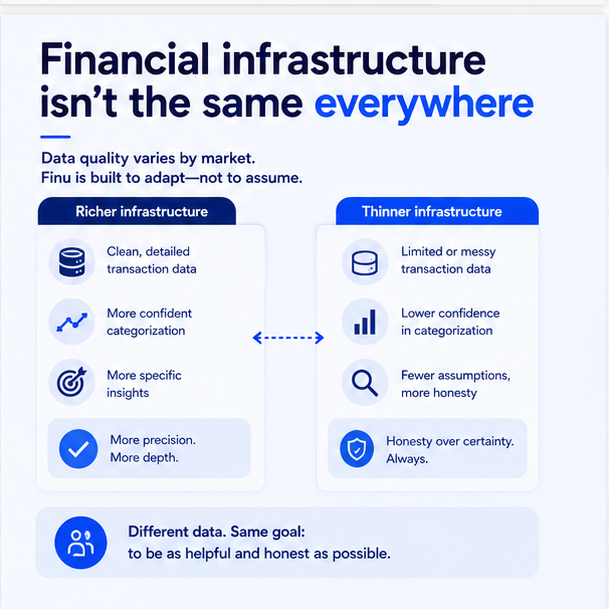
That meant designing for graceful degradation rather than assuming uniform data quality everywhere. In markets with richer infrastructure, Finu can be more specific and more confident. In markets with thinner data, it has to be honest about what it can and can't reliably tell you, rather than pretending the same precision is available regardless of what's actually coming through the pipe. Consistency of experience matters more than consistency of exact wording — the goal was never to say the identical thing everywhere, it was to be equally honest everywhere.
Spending behavior isn't universal either
Even with clean data, the patterns hiding in it don't mean the same thing everywhere. In some markets, cash still does a lot of the everyday spending that card transactions capture cleanly elsewhere — which means the same person could look like they're spending far less than they actually are, simply because part of their spending never touches a traceable rail at all. Bill cadence varies too: monthly billing is a default assumption in some places and a poor fit in others, where weekly or irregular payment patterns are just as normal.
Subscription culture, attitudes toward debt, and even what counts as a "big" purchase all shift by market as well. A pattern that would read as a clear warning sign in one context — rising recurring charges, say — might just be an accurate reflection of how services are normally paid for somewhere else. Treating every market's spending behavior as a variation on one default pattern would have meant misreading a lot of genuinely normal behavior as unusual, and missing genuinely unusual behavior that didn't look like the default at all.
Language is more than translation
Translating words is the easy 80%. The harder part is that a lot of financial language carries assumptions baked into the phrasing itself. "Credit score" doesn't map cleanly onto every market's credit system. "Paycheck" assumes a pay structure that isn't standard globally. Even something as basic as date formatting — is it day/month or month/day — can quietly cause someone to misread when a bill is actually due, which is exactly the kind of small failure that undermines trust fast.

Getting this right meant treating language work as a design problem, not a translation task handed off at the end. Tone, idiom, and the financial assumptions embedded in ordinary phrasing all needed to be reconsidered market by market — not just swapped word-for-word into a different language and called done.
Accessibility beyond the language layer
Accessibility here isn't only about supporting multiple languages — it's about the real range of devices, connectivity, and comfort levels people are actually using. Not everyone is on a fast connection or a recent phone. Not everyone comes in with the same baseline financial literacy, or the same comfort talking to an AI about money in the first place. Designing for one assumed "typical user" would have quietly excluded a lot of the actual people using the product.
That pushed decisions across the board — keeping the experience usable on lower bandwidth, keeping explanations plain rather than jargon-heavy by default, and not assuming a level of financial fluency that isn't evenly distributed just because someone happens to be a paying user.
What "one experience" actually means
None of this was about making Finu feel identical everywhere — that was never really the goal, and it wouldn't have been the right one. It was about keeping the same underlying principle intact everywhere it's used: real answers, grounded in someone's actual situation, instead of generic advice that quietly assumes a context that isn't theirs.
Doing that across more than 40 countries meant the personalization work from earlier in this series had to extend further than just "your history, your patterns, your goals." It had to include where you are, honestly and without shortcuts — because a financial answer that's accurate in one country and quietly wrong in another isn't really personalization at all. It's just personalization with a blind spot. Closing that blind spot, market by market, was the actual work.