

Open enough conversations between people and their money, and a pattern shows up fast. The questions aren't wild or unpredictable. They're the same handful, asked in a hundred different ways, by a hundred different people, on a hundred different Tuesdays. "Where did it all go?" "Is this normal?" "Can I actually afford this?" "Why do I keep doing this?"
We built Finu to sit inside those moments — not after the fact, when the damage is done and the guilt has set in, but right in the middle of the question, when someone is genuinely trying to understand themselves. After looking at the questions people bring to Finu again and again, a few clear categories emerged. None of them are about spreadsheets. All of them are about being human with money.
"Where did my money actually go?"
This is the big one. Not "what did I spend," which is a math question, but "where did it go," which is closer to a feeling of loss than a request for data.
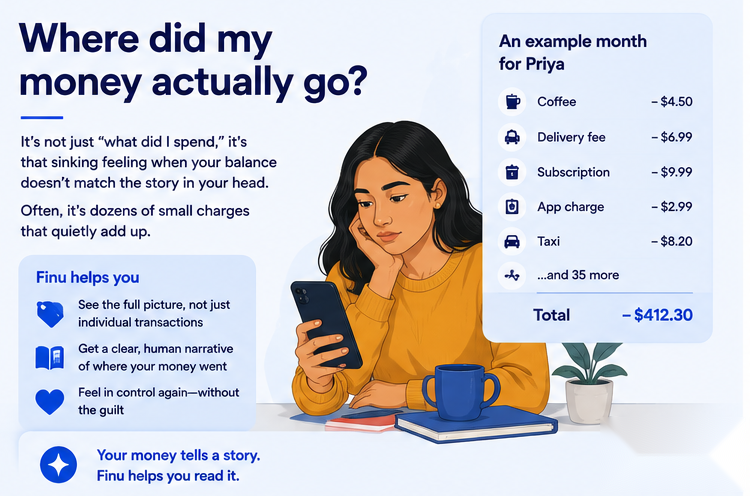
Take someone we'll call Priya, a Finu user who checked her balance one evening and felt that familiar drop in her stomach — the one where the number is lower than the story she'd been telling herself. She hadn't made one big purchase. There was no dramatic splurge to point to. It was forty small charges: a coffee here, a delivery fee there, a subscription renewal she'd forgotten about. Individually, each one made sense. Together, they told a story she hadn't been reading.
This is the gap Finu exists to close — not by shaming the forty small charges, but by narrating them back in a way that finally makes sense. "Where did it go" isn't really a question about transactions. It's a question about narrative continuity. People want their bank balance to match the story in their head, and when it doesn't, the instinct is to assume something's broken, either the account or themselves. Usually it's neither. It's just that daily spending is quiet, and quiet things are easy to lose track of.
"Is this expense normal, or is something wrong?"
The second most common question is really a request for reassurance dressed up as a request for information. Someone sees a spike in their spending — a vet bill, a broken phone screen, a wedding season with three invitations in one month — and they want to know: is this a blip, or is this a pattern I should be worried about?
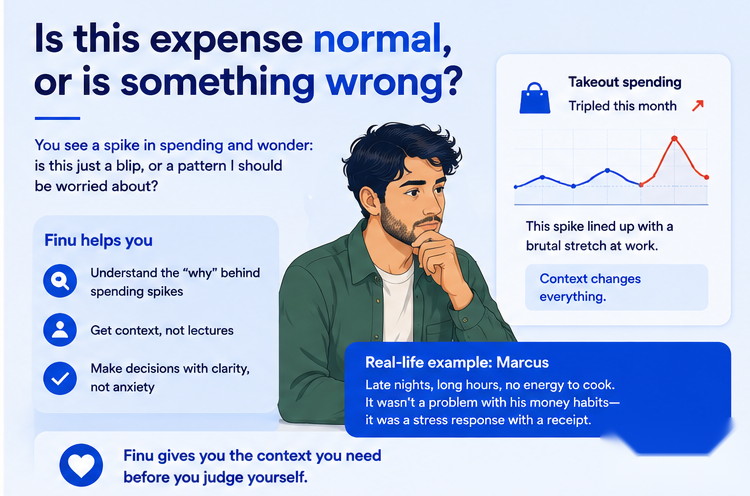
One Finu user, a guy in his late twenties we'll call Marcus, went through a month where his takeout spending tripled. He didn't need a lecture about meal prepping. He needed context. It turned out the spike coincided almost exactly with a brutal stretch at work — long hours, late nights, zero energy to cook. Once he saw it laid out that way, the anxiety mostly dissolved. It wasn't a mystery problem. It was a stress response with a receipt attached.
This is where affordability questions get interesting. "Can I afford this?" is rarely a pure math problem either. It's a question people ask when they want permission to stop feeling guilty about something they've probably already decided to buy. The honest answer isn't just a yes or no — it's showing someone the actual room they have, so the decision feels like theirs, not a verdict handed down by an app.
"Why do I keep paying for things I forgot I signed up for?"
Subscriptions deserve their own category because the emotional tone around them is different from everything else. Overspending on takeout can feel like a choice, even a bad one. A forgotten subscription feels like a small betrayal — money leaving your account for something you're not even using, on autopilot, without your permission in any meaningful sense.
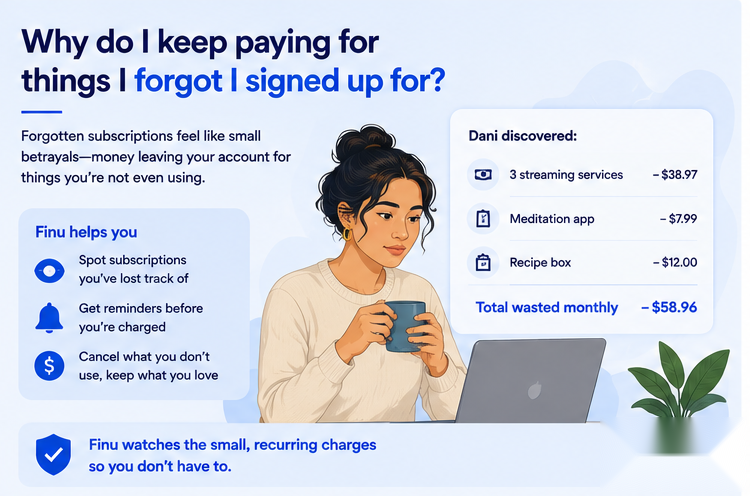
A Finu user we'll call Dani discovered she was paying for three streaming services, a meditation app she'd used twice, and a recipe box subscription she'd cancelled in her head but never actually cancelled in reality. None of these were large amounts on their own. Together, they were nearly sixty dollars a month leaving quietly, every month, for nothing.
What people want here isn't just a list. They want someone to notice on their behalf, because remembering every recurring charge across every account is a genuinely unreasonable task to expect of a busy person. The relief in these conversations isn't about the money saved, although that matters. It's about no longer being the only one keeping track.
"Am I overspending, or does it just feel that way?"
This question is trickier because the honest answer is often "a bit of both," and people don't always want to hear that. Overspending, as a feeling, is shaped by comparison, mood, and memory as much as by actual numbers. Someone can spend exactly the same amount two months in a row and feel fine about it one month and panicked about it the next, depending on what else is going on in their life.
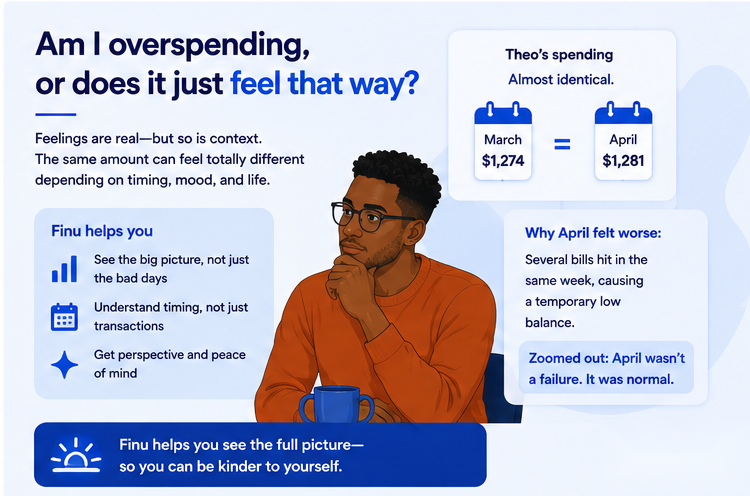
A Finu user named Theo had this exact experience. His spending barely moved between March and April, but April felt catastrophic to him. Looking closer, the difference wasn't the amount — it was the timing. In April, several bills landed in the same week, creating a short but intense low-balance stretch that felt like overspending even though, zoomed out, the month was completely ordinary. What he needed wasn't a warning. He needed the zoomed-out view, the one that showed him April wasn't a failure, just a bad week wearing a whole month's clothes.
This is a recurring theme: the feeling of overspending and the fact of overspending are not the same thing, and conflating them is one of the most common ways people end up either unnecessarily anxious or, just as often, unnecessarily complacent.
"How do I actually change this?"
The last question people bring is the hardest, and also the most hopeful, because it means they're done diagnosing and ready to act. "How do I change this?" almost never has a single clean answer, and pretending otherwise does people a disservice. What tends to work isn't a dramatic overhaul — cutting out every coffee, deleting every app — but a small, specific adjustment tied to a real pattern someone can actually see.
For Priya, that meant a simple nudge before her three highest-frequency small purchases. For Marcus, it meant separating "stress spending" from his regular budget so it stopped feeling like a moral failure and started looking like a predictable, plannable cost. For Dani, it meant a standing monthly check on recurring charges, so the sixty dollars a month never got the chance to hide again.
None of these are groundbreaking interventions. They work precisely because they're small, specific, and tied to something real the person already recognized about themselves.
What the questions have in common
Underneath all of it, the questions people ask about their spending aren't really about spreadsheets, categories, or percentages. They're about wanting to feel in control of a part of life that often feels chaotic and a little embarrassing to admit you don't fully understand. Nobody asks "where did my money go" because they want a pie chart. They ask because they want to feel less lost.
That's the job, really. Not to hand someone a ledger and walk away, but to sit with the question long enough to answer the real one underneath it — and to do it without judgment, because everyone, at some point, has stared at a bank balance and thought, how did that happen?