

Every month, tens of thousands of people open Finu and ask it something about their money. Stack enough of those questions next to each other and a shape starts to emerge — not a random scatter of one-off concerns, but a handful of categories that most questions, in disguise, actually belong to.
The most common question, wearing different outfits
If there's one question underneath more conversations than any other, it's some version of can I afford this? It rarely shows up in exactly those words. It shows up as "is it okay if I book this trip," or "should I get the nicer one," or "worth it if I cancel the gym instead," or just a screenshot of a cart with "thoughts?" typed underneath it.
What's notable isn't the question itself — it's how much weight people put on getting a real answer instead of a rule of thumb. Nobody asking "can I afford this" actually wants to hear "generally, financial experts recommend..." They want to know if they, specifically, right now, can afford this, specifically. That's the whole reason a grounded, personal answer matters more here than almost anywhere else in the product.
"Why did this happen" — the reconciliation questions
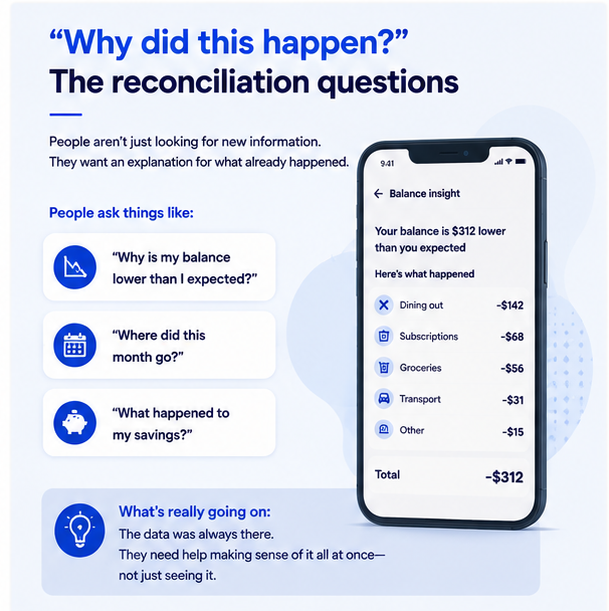
A close second is the category of questions that aren't really asking for new information so much as an explanation for something that already happened. "Why is my balance lower than I expected." "Where did this month go." "What happened to my savings." These aren't hypothetical — they're reactive, usually triggered by opening the app and noticing a number that doesn't match the story in someone's head.

What's interesting about this category is that the underlying data is often something the person technically had access to the whole time — it was sitting right there in their transaction history. The question isn't "give me the data," it's "help me make sense of the data I already technically had but couldn't hold in my head all at once."
"Am I normal" — the reassurance-shaped questions
This is the category that surprises people most when they first look at it, because it barely reads as a financial question at all. "Is this normal?" "Am I bad with money?" "Does everyone spend this much on food?" These questions aren't really asking for a number back — they're asking for reassurance, or permission, or just to feel less alone in a decision they've already half-made.
It's easy to underestimate how much of financial anxiety is really about not having a reference point, rather than not having a plan. A lot of people aren't struggling because their numbers are bad — they're struggling because they have no honest sense of whether their numbers are bad, and nobody in their life talks about this stuff plainly enough to tell them. Answering this category well means resisting the urge to just hand back a chart, because a chart was never actually what was being asked for.
Forward-looking questions: bills, timing, and "will I be okay by Friday"
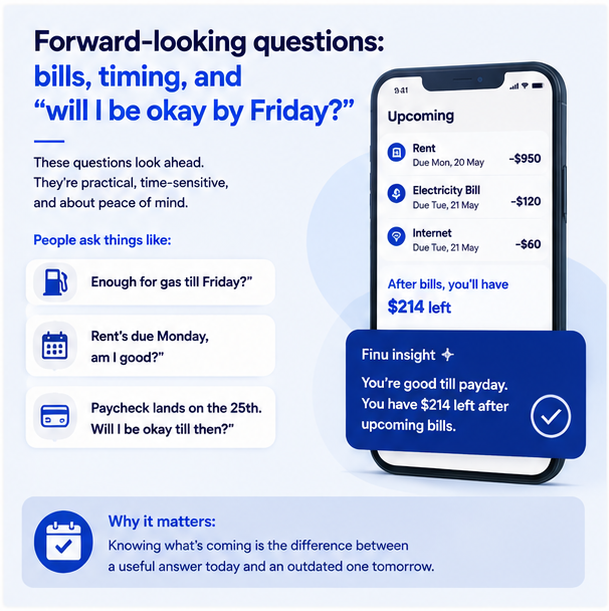
A steady stream of questions are less about the past and more about the immediate future — rent clearing in three days, a paycheck landing on a specific date, whether there's enough breathing room between now and payday to say yes to something. These are practical, time-sensitive, and usually short: "enough for gas till Friday?" "rent's due Monday, am I good?"
This category rewards exactly the kind of forward-aware context covered earlier in this series — knowing what's coming, not just what's already happened, is the difference between a genuinely useful answer here and a technically correct but unhelpfully backward-looking one.
Checking in on a goal already in motion
There's a quieter category that only shows up because of memory — questions that only make sense if something was already discussed before. "How's my savings goal doing." "Am I doing better than last month." "Did I actually cut back on takeout like I said I would." These aren't one-off questions; they're check-ins, and they only work if whatever's answering actually remembers the goal or the promise being checked in on.
This category is small in volume but says a lot about what people actually want long-term from something like this — not a single good answer, but an ongoing thread they can pick back up without re-explaining themselves every time. It's the difference between a tool and something closer to an actual accountability partner.
The occasional, higher-stakes questions
Less frequent, but heavier when they show up: questions about credit, bigger purchases, or whether to take on something new. These don't come up daily the way "can I afford this" does, but they carry more weight per question — the kind of thing someone thinks about for days before finally typing it out. "Should I use my card for this or wait and save up." "Is now a bad time to take on more credit." These are the moments where a generic answer does real damage if it's wrong, and where grounded, current context matters most.
The genuinely surprising pattern
If there's one thing that stands out across all of this, it's how rarely people are asking for a number as an end in itself. Almost every category above is really a decision or an emotion wearing the outfit of a financial question. "Can I afford this" is a decision. "Why did this happen" is often anxiety looking for an explanation. "Am I normal" is reassurance, plain and simple. Even the forward-looking questions are usually about peace of mind as much as arithmetic.
That's arguably the most useful thing to take away from the shape of these conversations: people don't open a financial AI because they want more numbers. They open it because they want to stop carrying the question around in their head unanswered. The data was always just the means. The actual thing being asked for, almost every time, is relief — a clear answer that lets someone put the question down and move on with their day.
Why this shape matters
None of this is a coincidence, and it isn't separate from everything else covered in this series. The reason categorization, context, memory, and a unified financial picture all mattered from the start is exactly because real questions look like this — messy, emotional, time-sensitive, rarely phrased the way a spreadsheet would expect. Building for the tidy version of these questions would have meant building for questions nobody actually asks. Building for the real shape of them — reassurance and decisions dressed up as data requests — is what the rest of this series has actually been about the whole time.