

Ask a generic AI chatbot "should I buy this?" and it'll give you an answer. A confident one, even. It just won't be right — because it has no idea what "this" costs, what you make, what's already spoken for in your account, or what you spent last week that's about to catch up with you.
That's the difference between a chatbot answering a question and a financial AI answering your question. One is working off a prompt. The other is working off your actual financial life.
A prompt is not a financial picture
A general-purpose LLM is, at its core, a very good language predictor. Type in a question, and it generates a plausible-sounding response based on patterns it's learned — not based on anything it actually knows about you. Ask it "can I afford a $200 weekend trip?" and it can only answer in generalities: rules of thumb, average savings advice, maybe a disclaimer to "check your budget first."
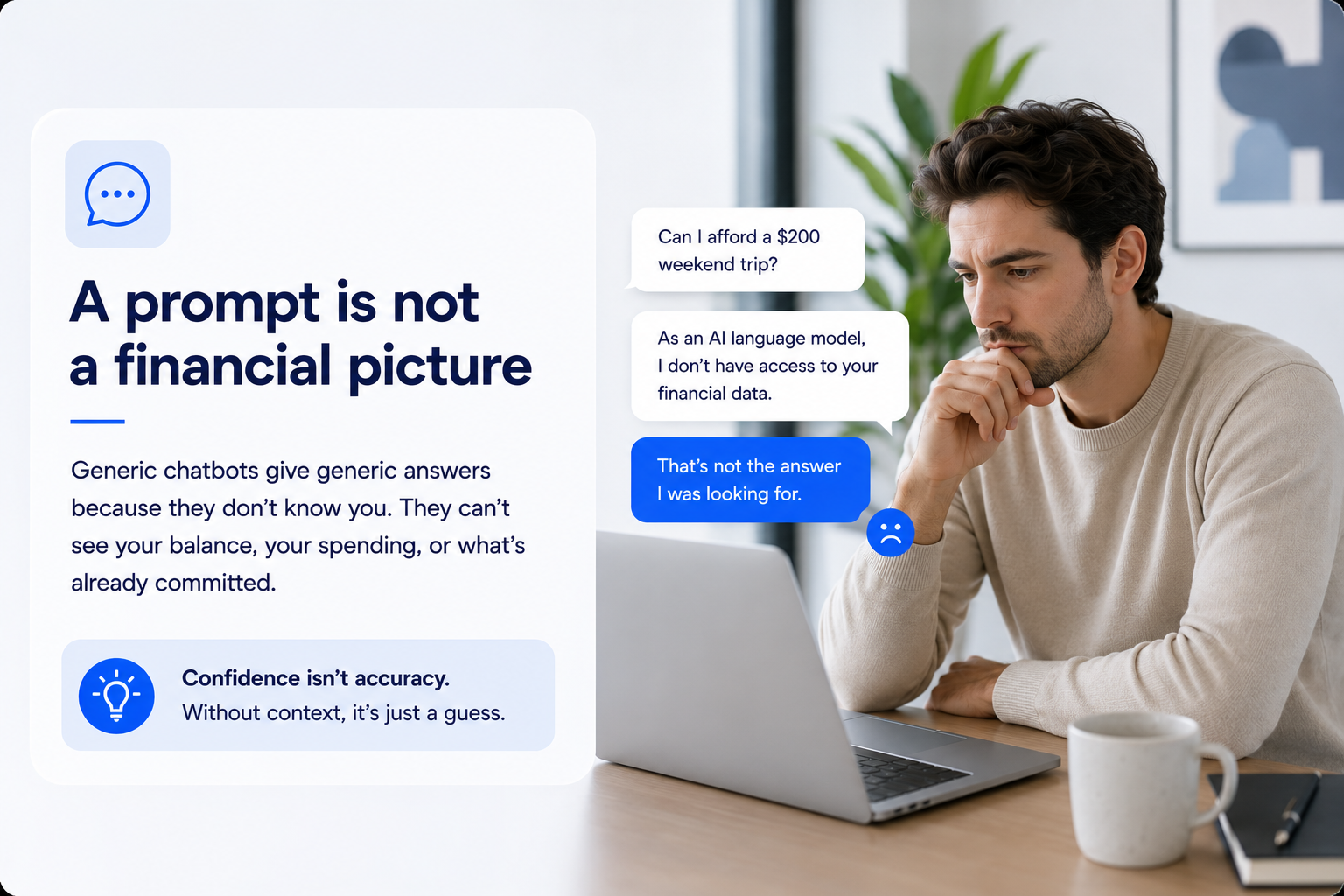
Push it further and the cracks show even more. Ask it "how much did I spend on groceries last month?" and a generic chatbot has exactly two options: admit it has no idea, or — worse — guess at something plausible-sounding. Neither one is what you actually asked for. You didn't want an estimate of what a typical person spends. You wanted your number.
That's not useless, exactly. But it's not an answer either. It's a guess dressed up as advice.
The gap isn't intelligence — it's grounding. A chatbot without financial context is reasoning in the dark. It sounds certain because that's what language models do; it just has nothing real underneath that certainty. Confidence and accuracy are two completely different things, and a naked prompt only ever gives you the first one.
What "context" actually means here
For Finu, context isn't a buzzword — it's the specific, real information a question needs to actually be answerable: your current balance, your recent spending by category, your recurring bills, the pattern of how your money typically moves through a month.
That's the layer built in the previous piece — turning thousands of raw transactions into categorized, pattern-aware financial understanding. Context is what happens when that understanding gets pulled into the conversation itself. Ask "can I afford this trip?" with context behind it, and the answer isn't a rule of thumb — it's grounded in what's actually left in your account after your upcoming bills, your recent spending pace, and whatever savings goal you've already told Finu matters to you.
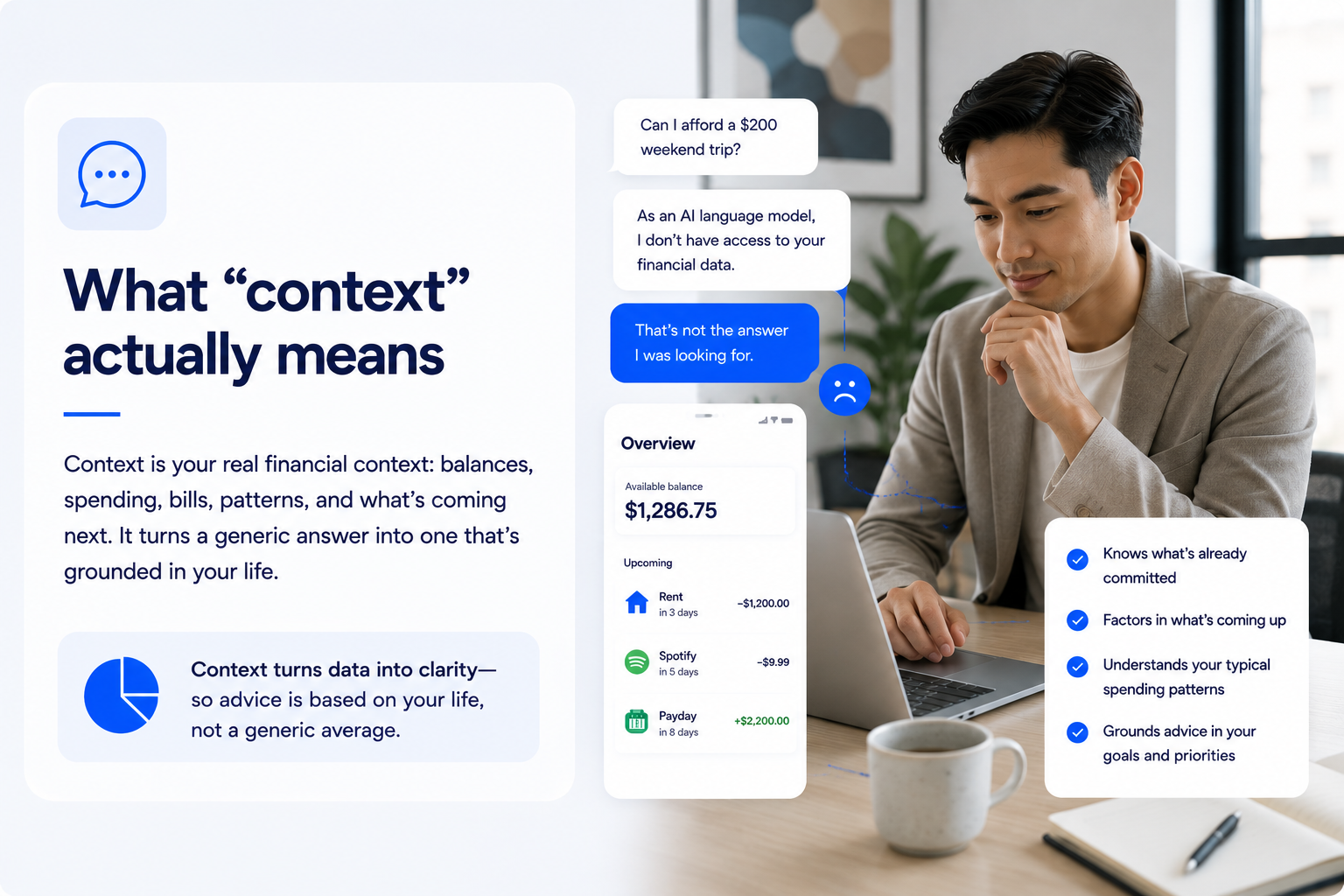
It also means knowing what's coming, not just what's already happened. A generic chatbot only sees the words you typed. Finu can factor in that rent clears in a few days, that a subscription renews next week, that payday is coming up soon — the kind of near-future context a person would naturally weigh themselves, if they had the patience to hold it all in their head at once.
The same question means something different for everyone
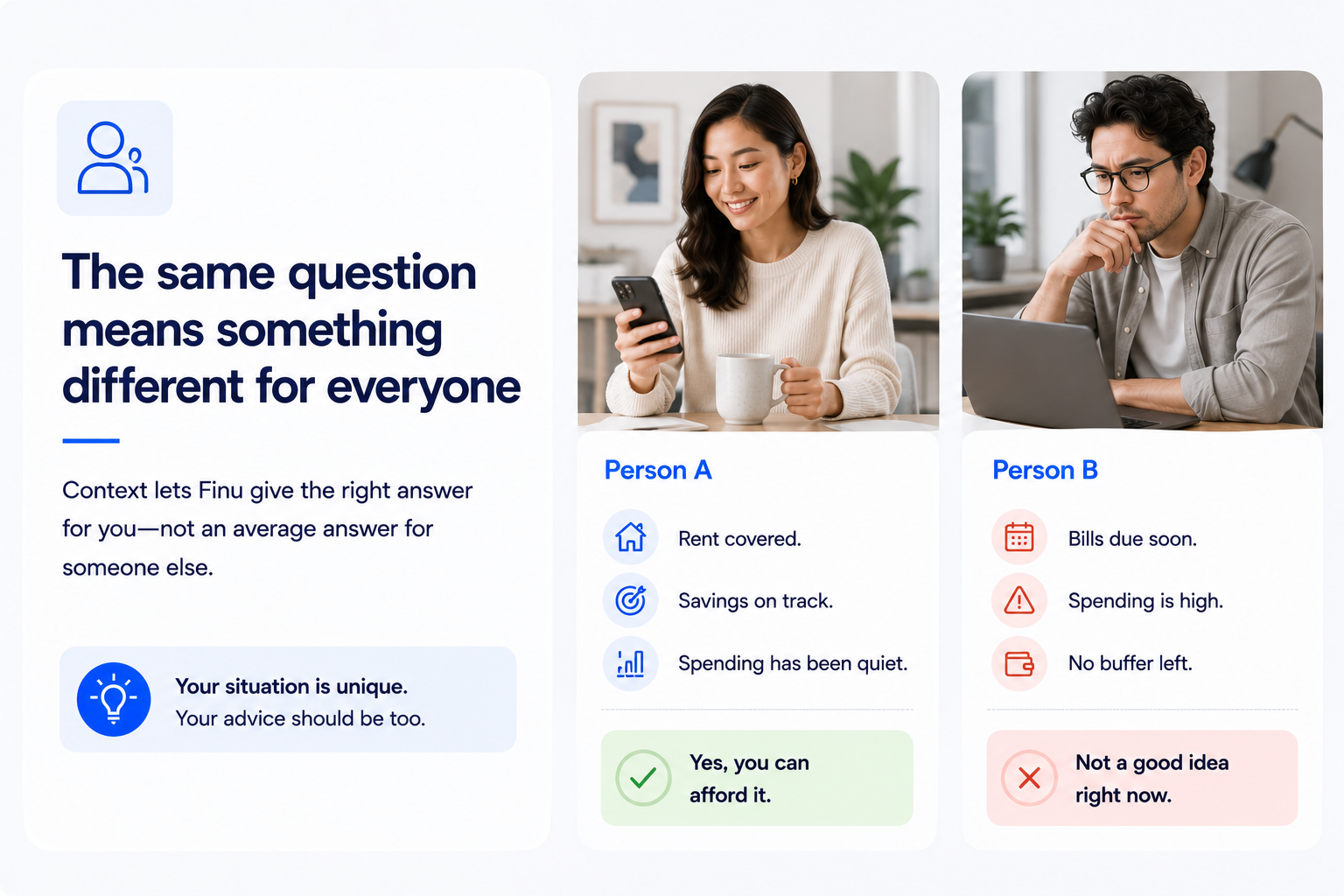
Here's the part that's easy to miss: "Can I afford this?" isn't one question. It's a different question for every single person who asks it, because the honest answer depends entirely on what's true for them.
For one person, that $200 trip is fine — rent's covered, savings goal is on track, spending this month has been quiet. For another, it means dipping into money already earmarked for something else, or spending right up against the edge of a bill that's due in a few days. A generic chatbot gives both people the same generic answer, because it genuinely can't tell them apart. Context is what lets Finu give each of them the right one — personalized not because it's flattering, but because it's accurate.
This is where a lot of financial advice quietly fails people: it's written for an average that doesn't actually describe anyone. "Save 20% of your income" is true in the abstract and not especially useful in the specific, because it doesn't know your rent, your student loan, or an income that fluctuates month to month. Context replaces the average with the actual — your actual number, not a textbook one.
Memory matters as much as data
A single snapshot of your finances is useful. A running understanding of them is more useful. Context isn't just "what does your account look like right now" — it's "what's normal for you," built up over time.
Without that history, every question gets answered like it's the first one you've ever asked. With it, Finu can notice things like: this month's spending is higher than usual for you specifically, not just higher in general — or, this is the third time this question has come up, maybe it's worth actually addressing the pattern instead of the one-off. That kind of continuity is what turns a chatbot into something closer to an actual financial assistant — one that remembers the conversation, not just the last message in it.
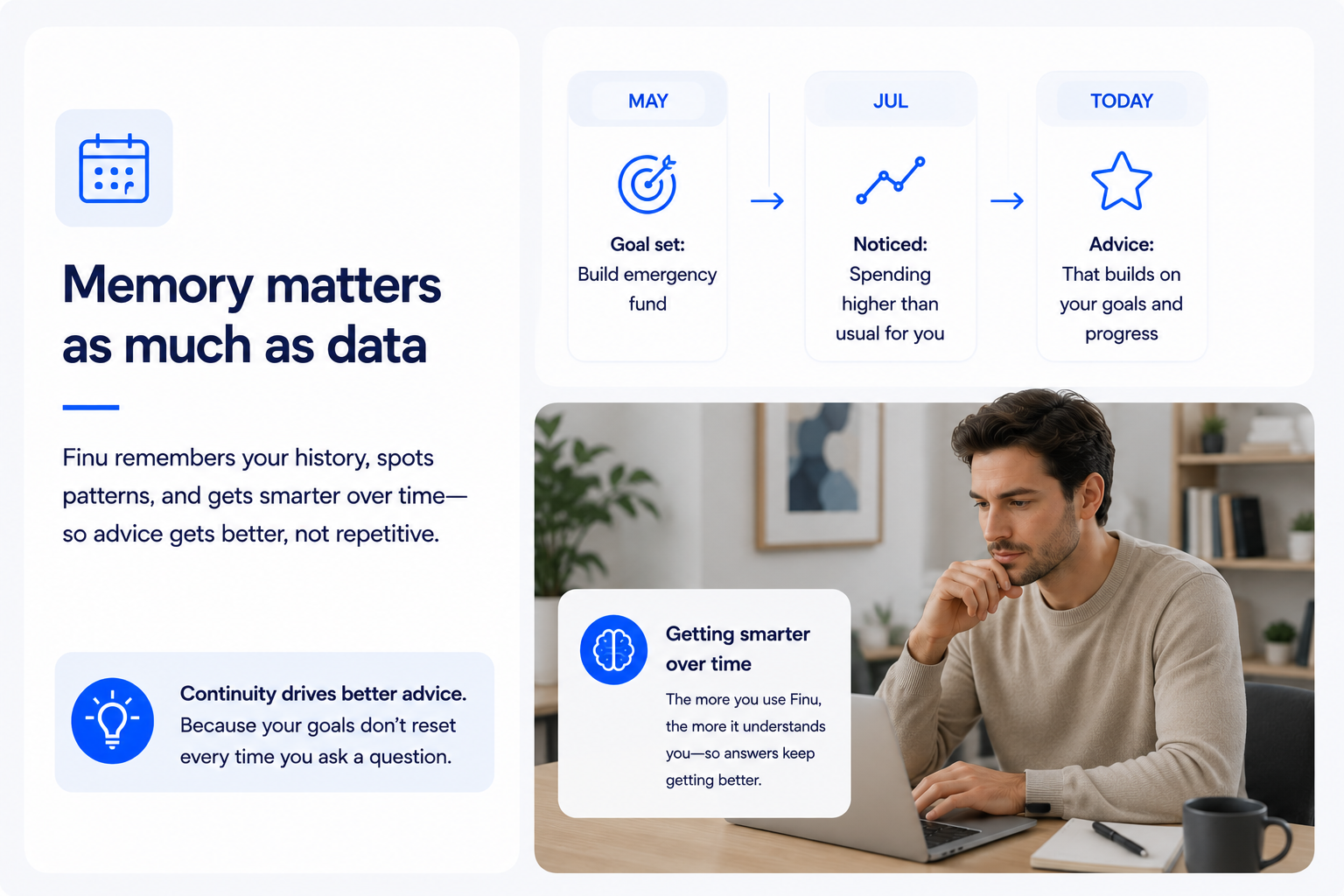
Memory also means the answers get better over time, not just repeat themselves. A goal you mentioned a couple of months back should still matter to the advice you get today. A spending habit you're trying to break should be something Finu is quietly tracking progress on, not something you have to re-explain from scratch every time you open the app.
Grounded doesn't mean rigid
None of this means the goal is to strip away nuance and just spit out cold numbers. Grounding an answer in real data doesn't make it robotic — if anything, it's what makes personality and warmth trustworthy instead of just decorative. It's easy to sound friendly when you're not on the hook for being right about anything specific. It's harder, and more valuable, to be warm and accurate at the same time — and that combination is only possible once the answer is actually built on something real.
There's also a quieter benefit here: grounding reduces the risk of an AI confidently making something up. When an answer has to trace back to your actual transaction history instead of a plausible-sounding pattern, there's simply less room for the AI to invent a number that feels right but isn't. That matters more in finance than almost anywhere else — a wrong restaurant recommendation is a shrug; a wrong answer about what you can afford is a real problem.
Why this actually matters
It comes down to trust. A confident-sounding wrong answer about your money isn't a minor miss — it's the kind of thing that costs you a late fee, an overdraft, or a plan built on numbers that were never really there in the first place.
Context is what makes an answer actionable instead of just plausible. It's the difference between "generally speaking, most people should save 20%" and "based on what's actually in your account, here's what you can safely put aside this month." One is advice you could've gotten anywhere, from anyone, without them knowing a single thing about you. The other is an answer only your own financial data could give you.
That's the whole point of building context in, rather than just building a prompt on top of a chatbot: the goal was never to sound smart. It was to be right.